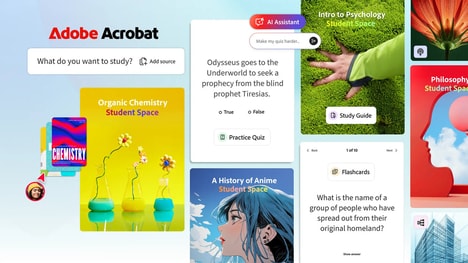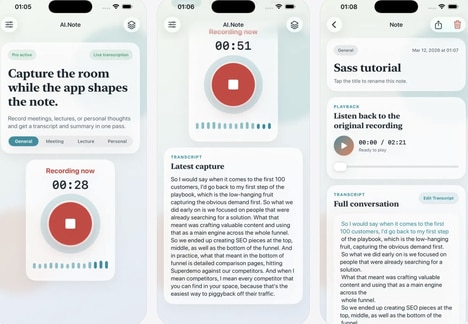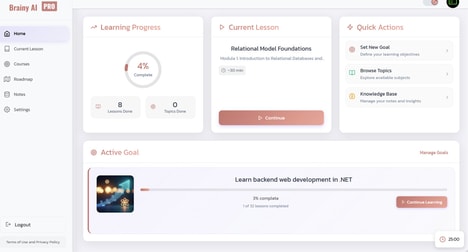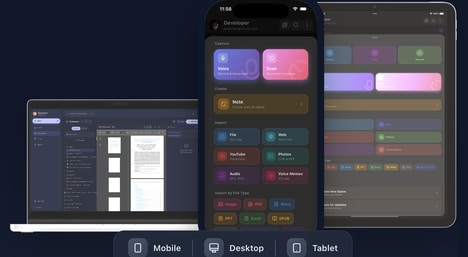
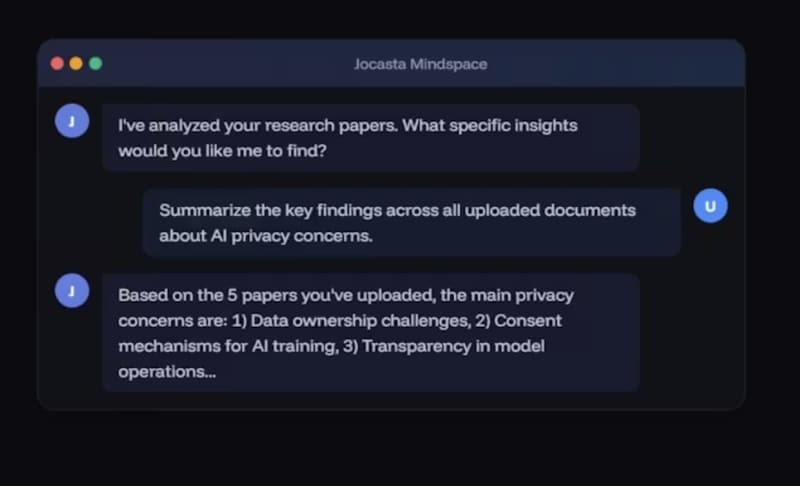
Managing information across notes, documents, and study materials can quickly become overwhelming, especially when insights are scattered across multiple sources -- Jocasta AI solves this by acting as a centralized “second brain” where users can store, query, and explore their knowledge.
The platform allows users to chat directly with notes, PDFs, and syllabi, making it easier to extract meaning, summarize content, and connect ideas. This transforms static documents into interactive learning tools. Designed with privacy and control in mind, Jocasta provides a modular workspace where users can organize thoughts and build understanding in a structured way. It supports deeper thinking rather than passive storage.
Jocasta AI is designed for students, researchers, and knowledge workers. By combining note-taking with conversational AI, it turns information management into an active learning experience.
Image Credit: Jocasta AI
What Makes This Trend Stand Out
- Conversational Note Interfaces
- Embedding chat-driven interactions into note systems could upend static documentation by enabling natural-language querying and synthesis across heterogeneous content.
- Private Second-brain Platforms
- Growing demand for personal knowledge vaults suggests a shift toward localized, privacy-first repositories that consolidate documents, notes, and contextual insights into one controllable system.
- Modular Knowledge Workspaces
- Composable workspaces that let users arrange and connect discrete knowledge modules may redefine collaboration and deep-thinking workflows by replacing linear files with networked idea maps.
Sectors Adopting This
- Education Technology
- AI-enhanced note tools for students and instructors point to transformative learning experiences where curricula, readings, and assessments become interactive and personalized.
- Research and Academia
- Researchers benefiting from integrated document querying could see a reconfiguration of literature review and hypothesis generation processes through accelerated synthesis of dispersed findings.
- Enterprise Knowledge Management
- Organizations adopting private second-brain systems may experience a fundamental change in institutional memory and decision support by turning siloed documents into searchable, context-aware knowledge assets.