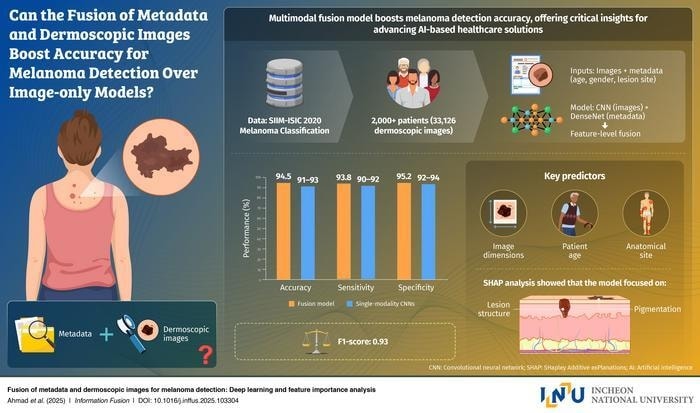
A research initiative led by Professor Gwangill Jeon from the Department of Embedded Systems Engineering at Incheon National University (South Korea), in collaboration with the University of West of England (UK), Anglia Ruskin University (UK), and the Royal Military College of Canada, has developed an artificial intelligence system that can help identify melanoma. This particular form of skin cancer is noted for its aggressive nature and for being challenging to diagnose in its initial stages because it can closely resemble benign skin growths.
The innovation coming from Incheon National University's system lies in its multimodal design — unlike conventional AI that depends exclusively on visual analysis of dermoscopic images, this model synergistically processes both those specialized photographs and relevant clinical information about the patient. This supplementary data includes factors such as the individual's age, gender, and the specific anatomical location of the suspicious lesion. By training on an extensive dataset comprising over 33,000 image-metadata pairs, the model learned to discern complex correlations between visual patterns and patient-specific contexts, achieving a diagnostic accuracy of 94.5% and outperforming established image-only AI models.
Image Credit: Incheon National University
Why This Trend Is Growing
- Multimodal AI Diagnostics
- Integrating diverse data sources into AI systems enhances diagnostic capabilities, pushing beyond traditional visual analysis to achieve higher accuracy.
- Precision Medicine Revolution
- Utilizing patient-specific metadata in AI models tailors diagnostics to individual profiles, marking a shift toward more personalized healthcare solutions.
- AI in Early Cancer Detection
- AI's proficiency in identifying malignant conditions at initial stages represents a transformative advancement in preventive healthcare technologies.
Industries Being Reshaped
- Healthcare AI Solutions
- The development of AI systems that analyze both images and clinical data is opening up new frontiers for medical diagnostics and treatment planning.
- Medical Imaging Technology
- Innovations that leverage AI to combine medical imagery with patient context can revolutionize existing medical imaging standards.
- Patient Data Analytics
- Analyzing metadata alongside traditional health parameters through AI introduces expansive opportunities for nuanced patient data insights.