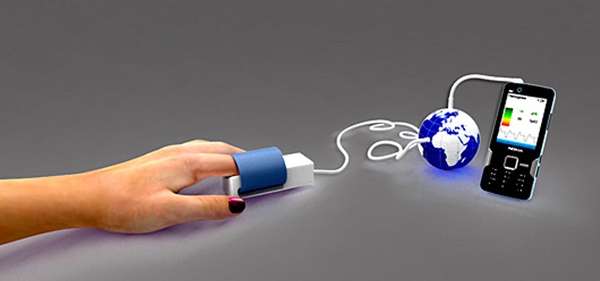
Researchers at John Hopkins University in Maryland have developed the HemoGlobe, a small smartphone attachment that can test for anemia. The sensor uses small wavelengths of light, not needles, to detect the level of hemoglobin in a person's blood. The results of the test are sent to a central database for further analysis.
The researchers at Johns Hopkins University estimate that the HemoGlobe could be manufactured for about $10 to $20 a piece. If mass produced, the HemoGlobe could be a big help to health workers in third world countries. A health worker who could use their phone to test for anemia could cover more ground than one who has to continually search for clean needles. The HemoGlobe has a shot at going into production as the team that developed it has won a $250,000 grant from Saving Lives at Birth: A Grand Challenge for Development competition.
Why This Trend Is Growing
- Anemia Testing with Smartphone
- The HemoGlobe attachment allows for quick and non-invasive blood tests for anemia using a smartphone, providing convenience and accessibility.
- Low-cost Medical Devices
- The HemoGlobe's estimated manufacturing cost of $10 to $20 per unit highlights the potential for affordable and scalable medical devices.
- Digital Health Solutions
- The HemoGlobe's ability to relay test results to a central database demonstrates the integration of digital technology in healthcare.
Industries Being Reshaped
- Healthcare
- The HemoGlobe presents an opportunity for healthcare professionals to improve anemia diagnosis and treatment through portable and cost-effective solutions.
- Mobile Technology
- The development of smartphone attachments like the HemoGlobe opens up possibilities for mobile health applications and advancements in diagnostics.
- Medical Device Manufacturing
- The HemoGlobe's low manufacturing cost and potential for mass production create opportunities in the medical device manufacturing industry to cater to global healthcare needs.