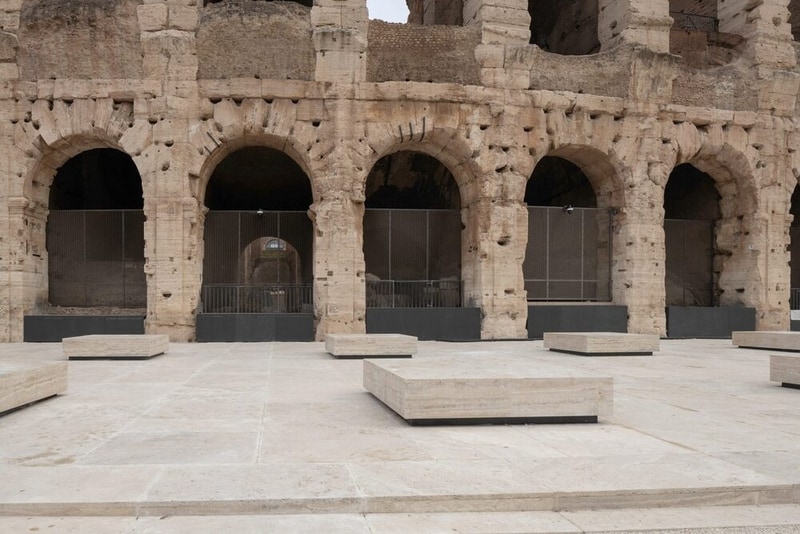
The Colosseum piazza project in Rome is a restoration by Stefano Boeri Interiors focused on the southern perimeter of the amphitheatre. The intervention lowers the surrounding ground level to reveal the crepidine, a double-step base that originally defined the monument’s edge. The redesign extends across the pedestrian zone, reorganizing circulation paths and access points around the Colosseum while maintaining the existing urban layout.
The paving uses travertine slabs arranged in a radial pattern aligned with the arches of the structure. Raised stone blocks indicate the positions of former columns and are used as seating elements within the space. An archaeological opening exposes portions of the original foundations, while engraved markings reinstate the numbering system of the arches along the facade. The work introduces new surface treatments and level changes across the site, with defined routes guiding movement along the southern edge.
Image Credit: Simona Murrone
What Makes This Trend Stand Out
- Heritage-led Urban Regeneration
- The project’s emphasis on revealing original edges and reestablishing historical layouts suggests opportunities for design approaches that fuse conservation with contemporary public-program interventions.
- Archaeological Integration in Public Spaces
- Exposed foundations and engraved arch numbering point to a growing practice of embedding archaeological narratives directly into everyday urban environments to deepen public historical awareness.
- Tactile Wayfinding Through Material Coding
- Radial travertine patterns and raised stone markers indicate a move toward using material textures and forms as intuitive orientation systems in pedestrian zones.
Sectors Adopting This
- Cultural Tourism
- Enhanced legibility of architectural history and on-site interpretive elements could transform visitor experiences and extend stay durations around heritage landmarks.
- Landscape Architecture
- Design strategies that reconcile archaeological preservation with circulation reorganization are defining new briefs for public realm practitioners.
- Urban Materials Manufacturing
- Demand for customized travertine paving, modular seating blocks, and durable engraved surfaces may drive innovation in heritage-sensitive material systems and fabrication techniques.