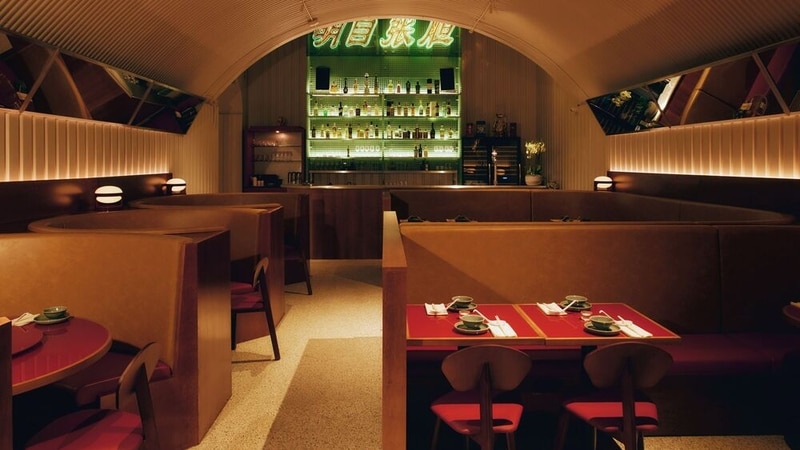
Cafe Kowloon is a Cantonese restaurant in East London designed by Daytrip Studio for hospitality group 6 of 1, located beneath railway arches on Mentmore Terrace. The interior draws on Hong Kong’s cha chaan teng cafés and street food stalls, translating their dense, high-energy environments into a layered dining space. The layout is split into two zones, with a noodle bar at the entrance leading into the main restaurant. Materials include stainless steel counters, maroon tiles, timber, leather, and industrial grating, combined with neon lighting and mosaic surfaces to build a textured setting.
The seating arrangement centers on communal dining, with banquettes and booth tables fitted with rotating lazy Susans to support shared dishes. The space incorporates tight spatial planning, open kitchen views, and layered material contrasts to reflect the intensity of Hong Kong dining culture.
Image Credit: Studio Hahn
Why This Trend Is Growing
- Adaptive Under-arch Restaurants
- Repurposing railway arches into dense, atmospheric dining rooms suggests new business models that capitalize on overlooked urban voids and micro-site hospitality economies.
- Cha Chaan Teng Revival
- A resurgence of Hong Kong-style café aesthetics points to opportunities for brands to translate nostalgic street-food culture into globally scalable casual dining formats.
- Communal-first Seating
- Emphasis on rotating lazy Susans and banquette clusters indicates demand for furniture and service systems engineered to optimize shared-plate social dining in compact footprints.
Industries Being Reshaped
- Hospitality Design
- Design practices focused on material layering, neon lighting, and open kitchens imply potential for modular fit-outs and experiential templates tailored to high-density, culturally specific concepts.
- Urban Redevelopment
- Converting transit-adjacent structures into culinary destinations reveals possibilities for mixed-use activation strategies that increase footfall and repurpose infrastructure assets.
- Food Service Technology
- The prominence of tight spatial planning and communal service formats highlights scope for compact kitchen automation, order-synchronization platforms, and tabletop-sharing technologies adapted to bustling, high-turn environments.