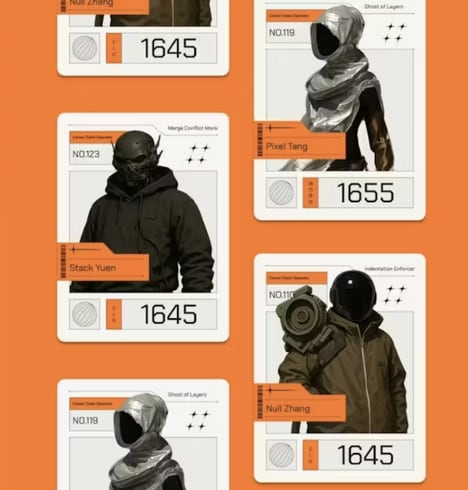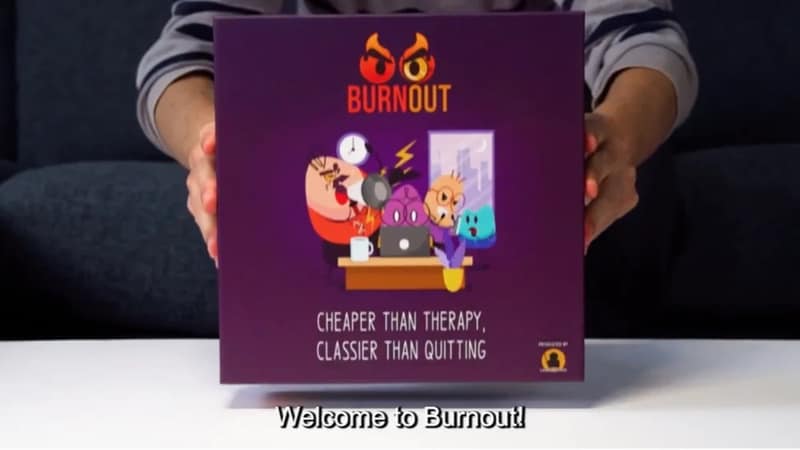
The Burnout Simulator game is a hand management card game for three to six players designed by Jannis Lim and Suren Rastogi, with artwork by Jennifer Lee, and published by Laughing Sticks Pte. Ltd. Players take the role of employees competing for a single promotion over six rounds, referred to as weeks, while managing two tracked resources: reputation and mental health.
Each week, players draw project cards that award reputation at the cost of mental health, and use action cards to modify, steal, or sabotage projects across the table. Scope change cards remain attached to projects as they move between players. A company announcement card is introduced each week to temporarily alter the rules.
If a player's mental health reaches zero, they burn out, losing reputation and discarding their hand before recovering to six mental health for the following week. The game ends after six weeks, with the highest reputation player winning the promotion. Custom wooden meeples represent each office character.
Image Credit: Burnout
What's Driving This Trend
- Gamified Workplace Simulations
- Products that simulate office politics and resource trade-offs create new experiential tools for assessing employee decision-making under pressure.
- Mental Health Mechanics in Entertainment
- Incorporating tracked wellbeing as a core game mechanic opens avenues for emotionally resonant content that reframes burnout as a measurable gameplay variable.
- Asymmetric Multiplayer Office Dynamics
- Tabletop systems featuring shifting project ownership and sabotage introduce novel models for studying competitive collaboration and incentive misalignment.
Who This Affects Most
- Corporate Training
- Serious games inspired by office card mechanics offer immersive scenarios that reveal vulnerability points in promotion pathways and team stressors.
- Board Game Publishing
- Publishers focusing on narrative-driven, socially reflective titles can capitalize on demand for experiences that mirror workplace tension and moral trade-offs.
- Digital Wellness Platforms
- Wellness apps that adopt gamified resource-tracking concepts could present quantifiable representations of mental load and recovery cycles for users.