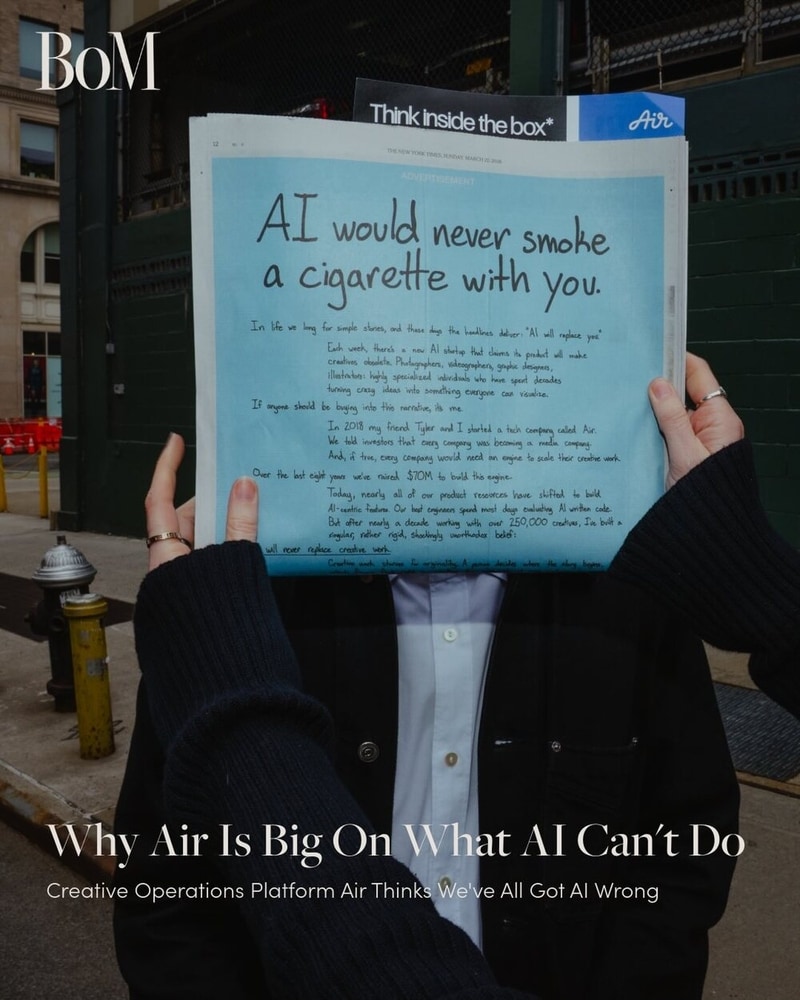
Air’s AI creative workflow platform introduces a new approach to creative work by shifting AI’s role from idea generation to execution and scaling. By learning brand guidelines such as fonts, visual identity, and tone, the platform enables teams to quickly adapt and reproduce assets across formats without starting from scratch. This reduces time spent on repetitive tasks like resizing and versioning, allowing creatives to focus on higher-value decision-making.
For businesses, this means faster content production, greater consistency across channels, and improved operational efficiency. Marketing teams, designers, and content creators benefit from streamlined workflows and reduced bottlenecks, while organizations can scale campaigns more effectively without increasing headcount. This model also reflects a broader shift in how companies use AI—prioritizing human judgment and creativity while leveraging technology to handle execution, ultimately enhancing both productivity and creative output.
Image Credit: Business of Marketing/Air
What's Driving This Trend
- AI-driven Brand Fidelity
- Platforms that internalize brand guidelines enable rapid, consistent asset generation across formats, reducing manual adaptations and preserving creative intent.
- Execution-focused AI
- Shifting AI from ideation to execution allows teams to scale content production while maintaining human-led creative decisions.
- Template-to-variant Automation
- Automated resizing and versioning of designs creates high-throughput customization that minimizes repetitive design labor and accelerates campaign rollout.
Who This Affects Most
- Marketing and Advertising
- Marketing operations gain the ability to produce channel-specific creatives at scale, improving campaign consistency and reducing time-to-market.
- E-commerce and Retail
- Retailers benefit from instant generation of product imagery and promotional variants that maintain brand standards across vast SKUs.
- Media and Publishing
- Publishers can repurpose editorial assets efficiently for multiple platforms, increasing output without proportional editorial hiring.