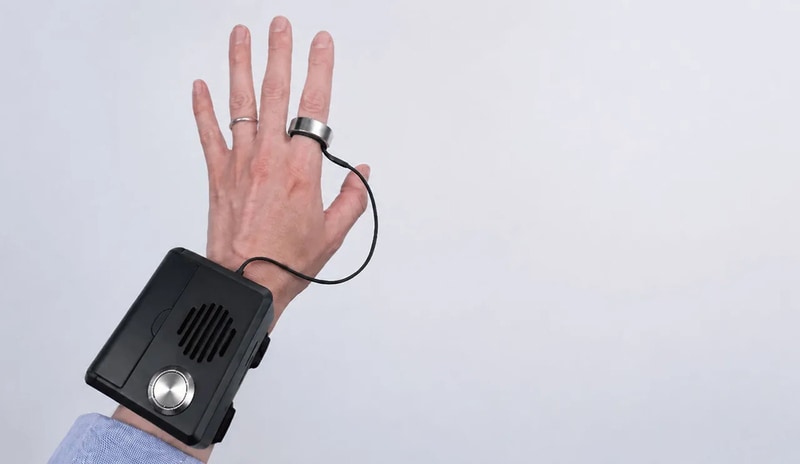
Sony Semiconductor Solutions Group has been working on a prototype device called the Ring Camera. This innovation is essentially a wearable image sensor worn on a finger that captures surrounding visual information and converts it into audio feedback via a connected smartphone. The goal of this venture is to help people with visual impairments read signs and maps, identify product packaging, detect obstacles, and understand traffic signals while keeping both hands free.
The Ring Camera, thus, addresses a key limitation of existing smartphone-based assistive technologies, which require the user to hold the device in one hand. As such, the innovation promises a more effortless and seamless experience. The ring form factor is discreet and can be worn as a piece of fashion, as well.
Sony Semiconductor Solutions Group is collaborating on this innovation with the National Museum of Emerging Science and Innovation, which actively incorporates feedback from people with disabilities throughout the process.
Image Credit: Sony Semiconductor Solutions Group
What Makes This Trend Stand Out
- Wearable Assistive Sensors
- A shift toward finger-worn image sensors that translate visual scenes into audio opens possibilities for low-profile, always-on accessibility devices that blend sensing, AI and haptics.
- Hands-free Visual-audio Interfaces
- The move from handheld to hands-free visual-audio systems creates room for multimodal interfaces that deliver contextual information without interrupting manual tasks.
- Discreet Assistive Fashion-tech
- Integrating assistive sensors into jewelry-like form factors suggests a convergence of adaptive functionality with mainstream fashion aesthetics and personal identity.
Sectors Adopting This
- Assistive Technology
- Compact ring cameras enable a new class of mobility and daily-living aids for people with visual impairments that emphasize discretion and continuous environmental awareness.
- Consumer Wearables
- Miniaturized image sensors paired with smartphones present opportunities for wearable ecosystems that extend beyond fitness to situational awareness and personal safety.
- Urban Mobility and Infrastructure
- Real-time wearable sensing for pedestrians has implications for crosswalks, signage and transit systems that could be augmented to communicate more effectively with personal assistive devices.