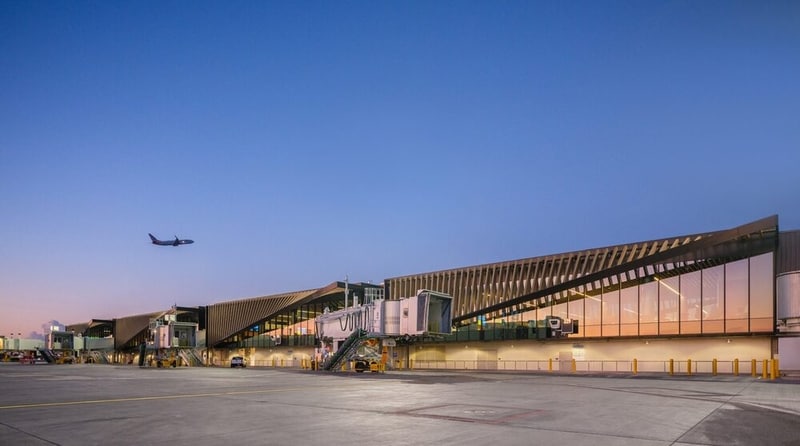
Woods Bagot’s modular terminal at Los Angeles International Airport expands the Tom Bradley International Terminal with a 150,000-square-foot concourse that includes eight additional gates. The structure was built using off-site construction, with large sections fabricated away from the airport and transported into place before assembly. This method reduced on-site disruption while allowing the concourse to be installed in segments that align with the existing terminal layout.
The exterior is defined by angled aluminium fins that act as a brise-soleil system, reducing solar gain while maintaining visibility and daylight inside the concourse. Floor-to-ceiling glazing runs along the perimeter, connecting interior circulation areas with runway views. Inside, the layout organizes passenger movement across two levels, with boarding gates, seating zones, and service areas distributed along the length of the structure.
Image Credit: Jason O'Rear
Why This Trend Is Growing
- Modular Off-site Construction
- Prefabricated terminal sections fabricated away from the airport allow scalable gate additions with shorter on-site schedules and repeatable quality controls.
- Adaptive Façade Shading
- Angled aluminium fins functioning as brise-soleil demonstrate façade systems that reduce solar gain while preserving daylight and runway views for passengers.
- Integrated Multi-level Circulation
- Two-level passenger organization along elongated concourses supports segregated flows for arrivals, departures, and services that optimize spatial efficiency.
Industries Being Reshaped
- Airport Construction
- Segmental assembly techniques create prospects for contractors to deliver complex expansions with minimal terminal downtime and predictable schedule windows.
- Architectural Façade Manufacturing
- High-precision aluminium fins and glazed systems point toward customized, performance-driven façade products that balance solar control with visual connectivity.
- Airport Operations & Passenger Services
- Elongated, multi-level concourses imply operational models where gate allocation, passenger amenities, and circulation logistics are harmonized to improve throughput.