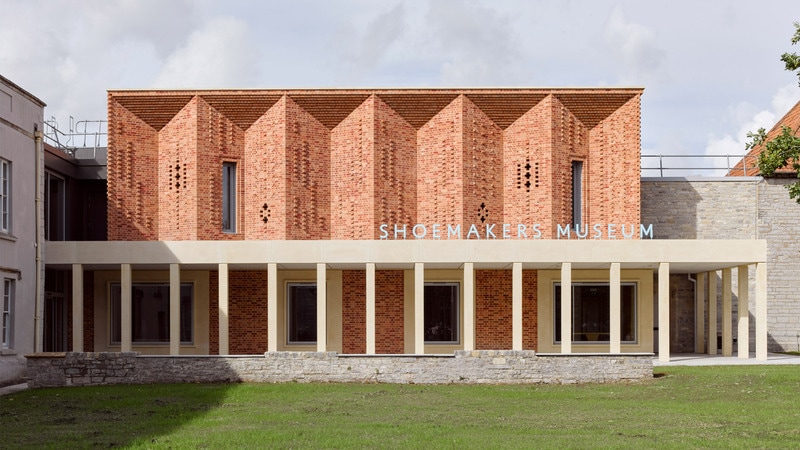
Shoemaker’s Museum is a cultural restoration project by Purcell that reimagines a Grade II-listed former agricultural building in Winchester, UK, as a museum dedicated to the craft of shoemaking. The design preserves the existing timber frame and masonry fabric while inserting new internal structures that accommodate exhibition spaces, workshops, and archival storage. The historic barn-like volume is retained as the primary spatial backdrop, and new interventions are detailed in a way that contrasts contemporary materiality with the original building fabric.
The museum’s layout organizes display areas along a sequence of rooms that maintain clear structural sightlines to the timber frame. Curated exhibits focus on tools, lasts, pattern books, and crafted objects that document shoemaking techniques and regional history. Service elements such as lighting, signage, and environmental controls are integrated discreetly to support exhibitions without obscuring the heritage features.
Image Credit: Nick Guttridge
What Makes This Trend Stand Out
- Adaptive Reuse Craft Museums
- Adaptive reuse of historic agricultural buildings into craft-focused museums presents opportunities to merge community heritage storytelling with contemporary visitor experiences that recontextualize traditional trades.
- Contrast Material Interventions
- The deliberate juxtaposition of contemporary materials against original fabrics creates possibilities for design languages that highlight authenticity while introducing modern functionality.
- Integrated Conservation Technology
- Discreetly embedded environmental controls and archival systems enable long-term preservation strategies that balance artifact care with minimal visual impact on heritage structures.
Sectors Adopting This
- Heritage Tourism
- Heritage tourism can leverage restored craft sites to deepen cultural itineraries and extend visitor engagement through immersive narratives tied to local industries.
- Museum Exhibition Design
- Museum exhibition design benefits from approaches that maintain structural sightlines while incorporating modular display systems tailored to delicate craft collections.
- Architectural Conservation Firms
- Architectural conservation firms encounter demand for solutions that reconcile structural preservation with the insertion of contemporary programmatic elements and building services.