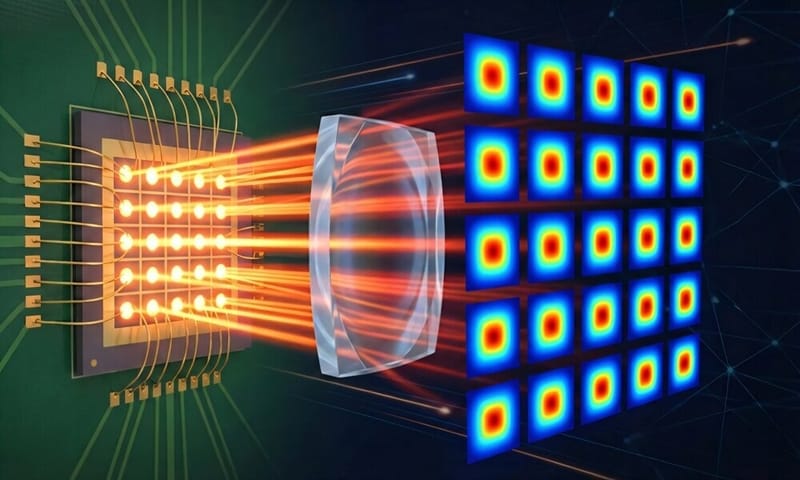
This optical wireless chip introduces a new way to manage rising indoor connectivity demands by transmitting data through infrared light instead of radio waves. In a study reported in Advanced Photonics Nexus, researchers developed a compact system built around a 5 × 5 array of vertical-cavity surface-emitting lasers, or VCSELs, enabling multiple high-speed data streams to operate simultaneously.
By directing light into structured beams, the system reduces interference in dense indoor environments while delivering significantly higher data capacity. It also improves energy efficiency, using less power per bit than traditional Wi-Fi, making it suitable for data-heavy applications like streaming and smart devices.
This technology creates opportunities for telecom providers and hardware companies to enhance indoor networks, reduce congestion, and lower energy costs across offices, hospitals, and data-driven environments.
Image Credit: University of Cambridge
What Makes This Trend Stand Out
- Indoor Light-based Networking
- A shift from radio-frequency to infrared-based data links is enabling high-capacity, low-interference indoor connectivity that could redefine network architectures in dense environments.
- Spatial Multiplexed VCSEL Arrays
- Structured multi-emitter arrays are allowing simultaneous parallel data streams from compact form factors, increasing per-device throughput and spatial reuse within a room.
- Energy-efficient Optical Data Transmission
- Optical links are delivering lower energy-per-bit compared with traditional Wi‑Fi, presenting pathways to reduce operational power consumption for continuous high-bandwidth services.
Sectors Adopting This
- Telecommunications Infrastructure
- Carrier networks and indoor service providers are positioned to integrate light-based access layers to alleviate RF congestion and expand capacity in buildings.
- Enterprise Office IT
- Corporate IT environments are being presented with alternatives to Wi‑Fi for supporting dense device populations and bandwidth-heavy collaboration tools with improved reliability.
- Healthcare Facility Networks
- Hospitals and medical campuses can benefit from high-throughput, low-interference optical links to support real-time imaging, telemetry, and privacy-sensitive data flows.