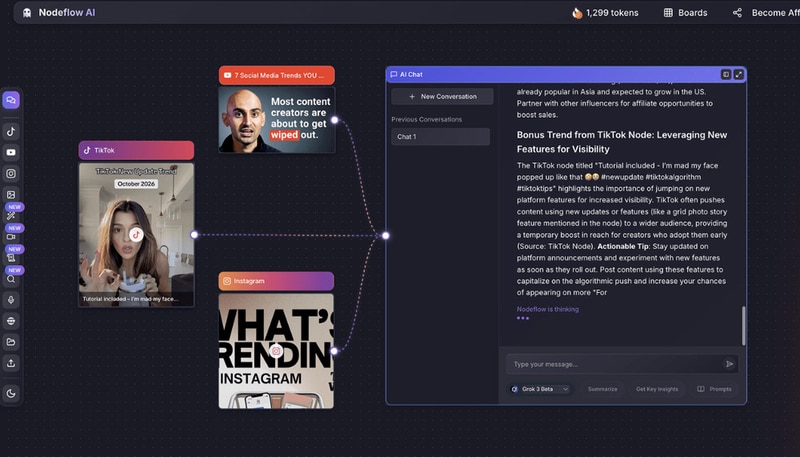
Nodeflow AI enters the market as a workflow orchestration tool designed to connect disparate content sources with generative AI models. Its node-based interface reflects a broader shift toward visual programming, lowering the barrier for non-technical users to build complex content pipelines.
From a business perspective, the platform targets creators, researchers, and students who increasingly operate across fragmented digital ecosystems. By enabling inputs from social platforms, documents, and websites, Nodeflow AI positions itself as a central hub for synthesis and content generation. This aligns with rising demand for tools that consolidate research, automate ideation, and streamline production. Its long-term viability will likely depend on integration depth, output reliability, and its ability to differentiate in an increasingly competitive AI tooling landscape focused on productivity and cross-platform efficiency.
Image Credit: Nodeflow AI
What Makes This Trend Stand Out
- Visual Node-based Programming
- A shift toward node-based visual interfaces is enabling non-technical users to assemble complex AI pipelines, potentially democratizing advanced automation and lowering integration costs.
- Multi-source Content Unification
- Consolidating social feeds, documents, and websites into a single processing layer is creating opportunities for unified context-aware outputs that reduce fragmentation across workflows.
- Generative AI Workflow Orchestration
- Coordinating multiple generative models and data sources through orchestration layers is emerging as a way to scale customized content production while managing model-specific strengths and weaknesses.
Sectors Adopting This
- Education Technology
- Platforms that let students and educators synthesize multimedia course materials and research from varied sources could transform personalized learning pathways and assessment methods.
- Content Creation & Media
- Integrated pipelines that pull social trends, raw footage, and editorial notes into generative systems are reshaping content ideation, speed-to-publish, and cost structures for studios and publishers.
- Research & Knowledge Management
- Centralized orchestration of disparate datasets and literature could enable more reproducible syntheses and faster hypothesis generation across academic and enterprise research teams.