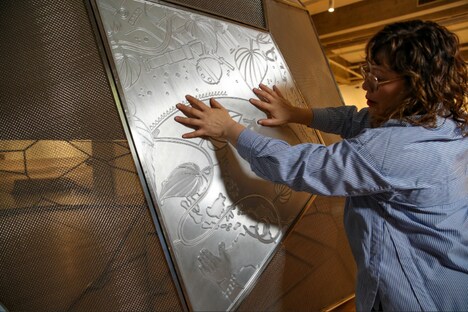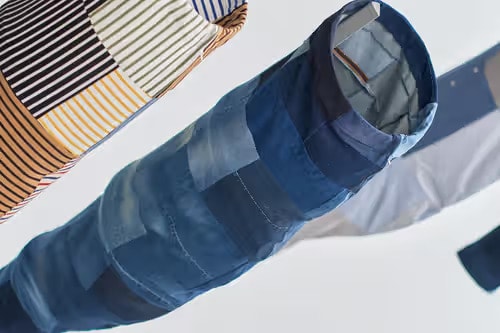
The Koi Continuum installation at Japan Society in New York City examines repair, reuse, and textile longevity through materials connected to MUJI’s REMUJI initiative. Created by Reiko Sudo with exhibition design by Adrien Gardère, the installation incorporates repaired garments, reused fabrics, and suspended textile elements arranged throughout the gallery environment. The project forms part of MUJI’s broader REMUJI program focused on extending the lifespan of used clothing and household textiles.
The installation presents layered fabric structures and reconstructed textile surfaces through modular display arrangements within the exhibition space. Repaired and reworked materials are positioned across hanging forms and spatial interventions that emphasize visible signs of reuse rather than concealment. Koi Continuum uses textile-based installation design to frame MUJI’s repair-focused processes through material repetition, suspended composition, and garment transformation within the gallery setting.
Image Credit: MUJI
What's Driving This Trend
- Visible Mending Aesthetic
- An increased emphasis on repair as a visible craft positions aestheticized mending as a value-bearing attribute that redefines garment desirability and storytelling.
- Modular Textile Systems
- Interconnected panels and suspended components suggest scalable, reconfigurable textile modules that enable adaptive interior and wearable assemblies over time.
- Circular Retail Narratives
- Retail frameworks that foreground reuse and repair through curated exhibitions and branded programs create new consumption narratives centered on longevity rather than replacement.
Who This Affects Most
- Apparel Manufacturing
- Processes and supply chains could shift toward producing garments designed for disassembly, repairability, and material reclamation to extend product lifecycles.
- Interior Design and Exhibitions
- Spatial practices that incorporate repaired and modular textiles open opportunities for immersive storytelling and long-term adaptable installations in commercial and cultural spaces.
- Retail Product Lifecycle Services
- Services centered on repair, resale, and refurbishment present potential to transform retail business models from one-time sales to ongoing material stewardship relationships.