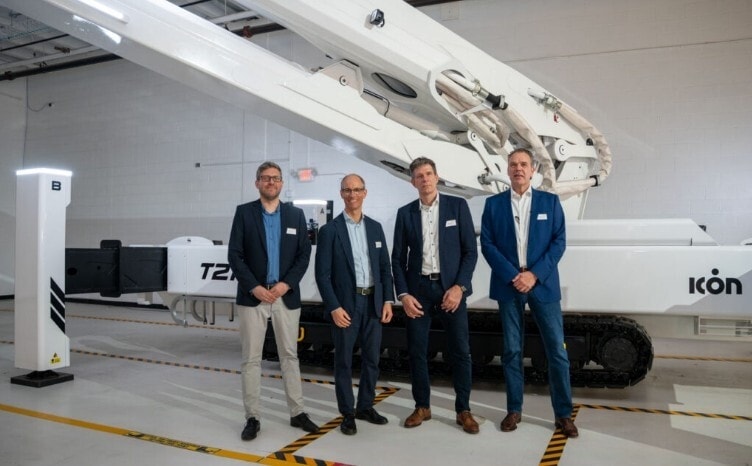
ICON introduced the Titan system, a large robotic construction printer, and has partnered with Austrian crane and lifting specialist PALFINGER to support field deployment, featuring PALFINGER’s stabilization and lifting technology to position and steady the platform. The collaboration accompanied ICON’s move to open Titan sales so builders can operate the equipment directly, with the system designed to print multi-level wall systems up to 27 feet tall.
Titan uses modular components and crawler stabilizers for continuous, around-the-clock operation and aims to lower on-site costs to roughly $20 per square foot, improving scalability and project economics. By pairing ICON’s additive platform with PALFINGER’s heavy-equipment expertise, the partnership helps integrate 3D printing into standard construction workflows, enabling more repeatable, faster builds where speed and site adaptability matter most.
Image Credit: ICON
Key Themes Behind This Trend
- Modular Robotic Construction
- Modular, reconfigurable print systems enable multi-level wall fabrication that can be scaled to diverse site conditions, creating opportunities to rethink on-site assembly and customization.
- Around-the-clock Additive Fabrication
- Continuous-operation crawler stabilizers and durable components support round-the-clock printing, shifting cost structures and timelines for large projects toward higher throughput and lower per-square-foot costs.
- Integrated Field-deployment Partnerships
- Collaborations between additive-platform developers and heavy-equipment specialists combine precision printing with proven stabilization and lifting solutions, reshaping how advanced machinery is introduced into mainstream construction workflows.
Where This Applies
- Commercial Construction
- Large-format 3D printers capable of producing 27-foot wall systems have the potential to alter bidding models and labor requirements across mid- to large-scale building projects.
- Heavy Equipment and Lifting
- Companies offering stabilization and positioning hardware can expand from traditional lifting roles into integrated platforms that support autonomous and semi-autonomous construction machines.
- Prefabrication and Offsite Manufacturing
- Printable, modular wall systems create possibilities for hybrid workflows that blend factory-precast elements with on-site additive finishing, affecting supply chains and inventory practices.