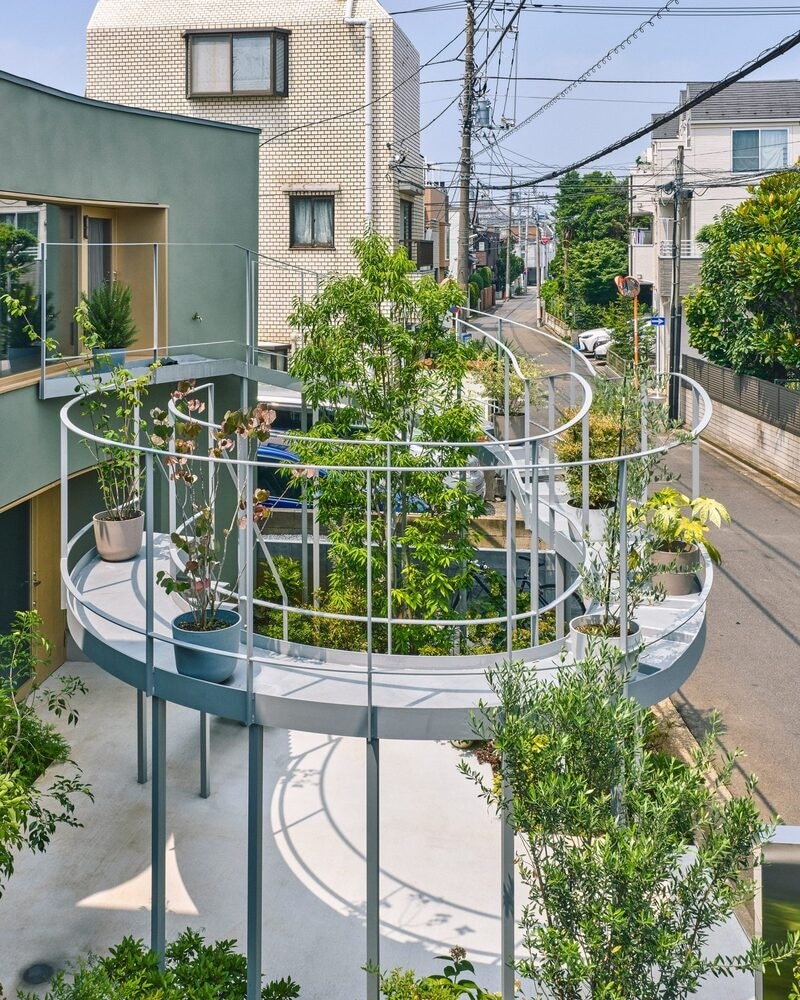
House in Nakano is a residential project in Tokyo designed by HOAA that responds to a narrow urban site with a layout that balances daylight access, privacy, and spatial flow. The house is arranged around a central void that brings daylight into the core of the plan from roof and clerestory openings, reducing reliance on side windows that face neighboring buildings. The façade reads as a series of layered volumes with subtle shifts in plane and material to articulate the building’s internal program while maintaining a quiet presence on the street.
The interior spaces are organized across multiple levels with living areas opening onto internal balconies that overlook the central void. Kitchen, dining, and living zones are connected visually and spatially through strategic openings, while private bedrooms and service areas are positioned to optimize views and circulation. The materials such as timber flooring, painted surfaces, and minimal detailing, contribute to a cohesive interior language that emphasizes light and transition between spaces.
Image Credit: Takuya Seki
Key Themes Behind This Trend
- Central Void Daylighting
- The central void strategy reveals potential for compact buildings to deliver deep natural light to interior cores, challenging conventional reliance on perimeter glazing.
- Layered Façade Articulation
- Layered planes and subtle material shifts present a façade model that expresses internal program and negotiates privacy without large street-facing openings.
- Stacked Multi-level Flow
- Interconnected split-levels and internal balconies illustrate a typology that maximizes perceived space and circulation on narrow footprints, shifting expectations for amenity in small urban homes.
Where This Applies
- Residential Architecture
- A sector where daylighting strategies, privacy sequencing, and vertical spatial planning can redefine briefs for narrow-lot infill housing.
- Prefabricated Housing
- Modular production embracing central-void modules and articulated façade panels could produce repeatable, privacy-focused compact dwellings with improved daylight performance.
- Urban Real Estate Development
- Infill developers may place higher value on layouts that increase daylight and perceived space in small units, affecting valuation and marketing approaches in dense neighborhoods.