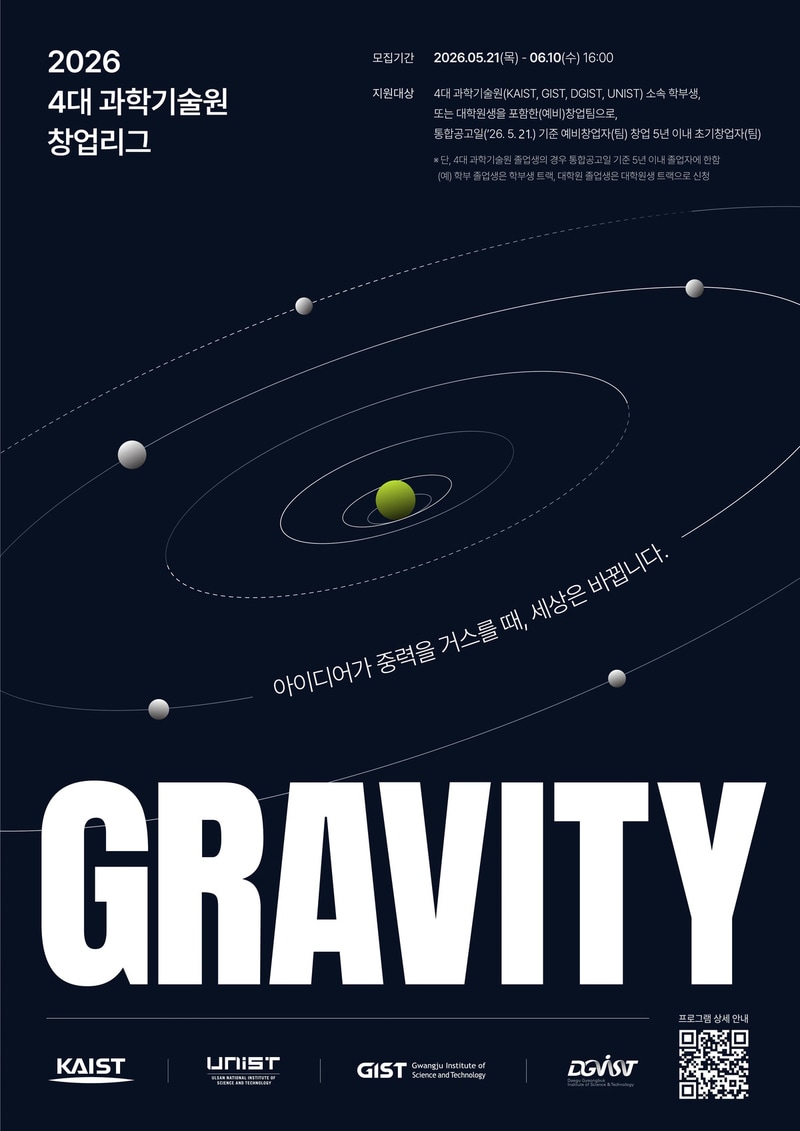
DGIST, KAIST, GIST and UNIST launched GRAVITY 2026, a student startup competition designed to support science- and technology-based ventures through funding, mentoring and global expansion opportunities. Positioned as South Korea’s largest startup league among science and technology institutes, the program targets pre-startup and early-stage teams working in fields such as AI, biohealthcare, robotics and aerospace.
The competition includes separate undergraduate and graduate tracks and progresses through institutional rounds, semifinals and finals. A total of 140 teams will receive startup funding and tailored mentoring, while the top 10 teams will compete for prizes worth up to KRW 200 million and gain access to overseas acceleration programs connected to global venture capital firms.
For student entrepreneurs, GRAVITY 2026 provides a structured pathway from academic innovation to startup formation by combining capital, expert guidance and international market exposure. The initiative reflects a broader trend of universities expanding their role in venture creation and supporting the commercialization of deep-tech research.
Image Credit: GRAVITY 2026
What Makes This Trend Stand Out
- University Venture Leagues
- Campus-led competitions are becoming structured venture pipelines where academic research, seed funding and mentorship converge to accelerate deep-tech company formation.
- Student Deep-tech Commercialization
- Early-stage science and engineering teams are gaining new pathways to transform lab-based breakthroughs into market-ready startups with global growth potential.
- Global Accelerator Access
- International venture connections are expanding the reach of university-backed startups by linking student founders with overseas capital, customers and commercialization networks.
Sectors Adopting This
- Higher Education
- Universities are evolving into entrepreneurial platforms that combine research infrastructure, founder training and investment channels to support next-generation venture creation.
- Venture Capital
- Investor ecosystems are finding earlier entry points into AI, robotics, biohealthcare and aerospace startups through curated university competitions and accelerator partnerships.
- Deep-tech Innovation
- Science-based sectors are benefiting from institutional startup leagues that reduce commercialization barriers for technically complex ideas emerging from academic labs.