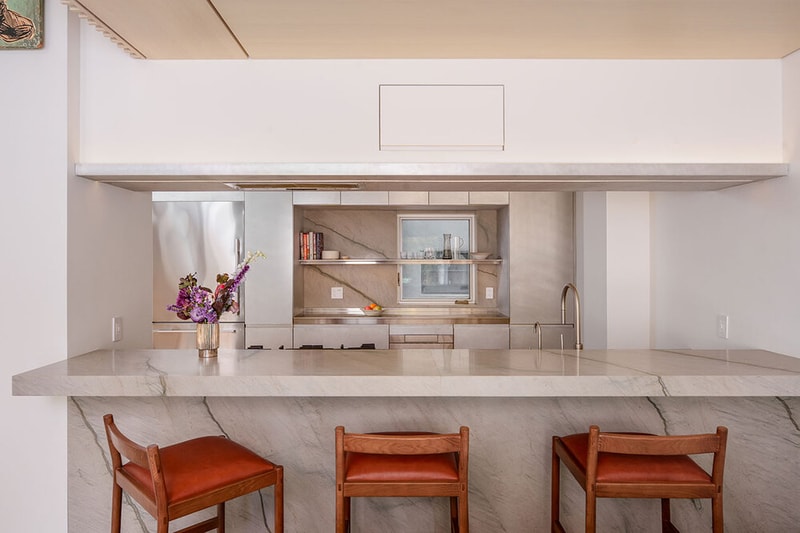
The Garden Apartment by Aranda\Lasch reimagines a Lower East Side residence as a spatial system organized around light, framing, and a private outdoor garden. The project centers on a rare double-width garden, treating it as the primary anchor rather than a secondary amenity. A newly introduced double-height volume pulls daylight deep into the interior, restructuring the previously compact layout into an open sequence of living, dining, and circulation zones. The apartment functions as a viewing device, continuously orienting interior life toward the exterior landscape.
Openings are composed as a series of calibrated thresholds rather than a single transparent facade, balancing visibility with enclosure. Expanded glazing dissolves boundaries while maintaining depth through layered framing. Reeded white oak volumes flank the central space, aligning with exterior textures to create continuity between inside and out. A restrained palette of oak, terrazzo, terracotta, and brushed metal defines distinct zones while maintaining cohesion.
Image Credit: ArandaLasch
What's Driving This Trend
- Light-centric Spatial Systems
- Design approaches that organize interiors around daylighting reveal opportunities for spatial products and services that treat light as the primary programmatic element.
- Threshold Framing Architecture
- The choreography of calibrated openings and layered frames points to novel building components that modulate visibility and privacy without relying on single-pane transparency.
- Material Layering for Continuity
- Integrated use of matched exterior and interior textures suggests potential for modular material systems that create perceptual continuity between indoor and outdoor environments.
Who This Affects Most
- Residential Architecture
- Boutique and multifamily firms may find competitive differentiation in designs that reorient units around private outdoor anchors and daylight-driven circulation.
- Smart Glass and Glazing
- Manufacturers of dynamic glazing and calibrated storefront systems could capitalize on demand for glazed solutions that balance openness with staged enclosure.
- High-end Interior Finishes
- Producers of bespoke wood, terrazzo, and metal finishes stand to benefit from integrated finish kits tailored to create cohesive, layered spatial palettes.