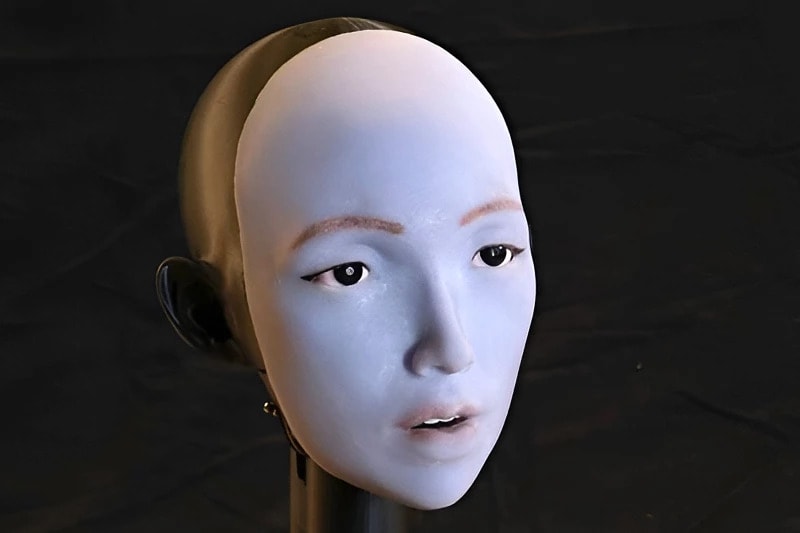
Columbia University researchers developed the EMO robot, a robotic head featuring a flexible silicone face driven by 26 miniature motors to closely mimic human lip movements. Created by robotics PhD student Yuhang Hu, Prof. Hod Lipson, and colleagues, the system was designed to learn how to speak like a person by watching itself and others. Instead of being manually programmed for each expression, EMO experiments with motor combinations to discover how different facial shapes look.
The team first positioned EMO in front of a mirror, where it cycled through thousands of random expressions while recording the resulting visuals. This process produced a “vision-to-action” language model that links specific motor patterns with observed facial configurations. EMO then analyzed hours of YouTube footage of people talking and singing, correlating mouth positions with particular speech sounds. Its AI combines these datasets to synchronize its silicone lips with a synthetic voice in near real time.
For consumers and designers, EMO showcases how realistic facial animation can deepen human–robot interaction in social, service, and entertainment contexts. What sets this system apart is its self-taught, data-driven approach, which allows it to refine difficult sounds like “B” and “W” through continued practice. As conversational AI improves, this type of lifelike, context-aware expression could make digital assistants, companion robots, and educational tools feel more natural and emotionally legible.
Image Credit: Creative Machines Lab
What Makes This Trend Stand Out
- Vision-guided Robotics
- The emergence of vision-guided systems in robotics enables robots to independently learn and perfect tasks like human facial expression replication.
- Self-taught AI Models
- AI models that teach themselves through observation offer new possibilities for reducing manual programming and increasing adaptability in robotic applications.
- Emotionally Expressive Robots
- The development of robots capable of realistic and context-sensitive facial expressions enhances the potential for more engaging human–robot interactions in various settings.
Sectors Adopting This
- Social Robotics
- Social robotics is increasingly focusing on enhancing human–robot interaction using lifelike expressions for applications in companionship and customer service.
- Conversational AI
- Innovations in conversational AI, paired with realistic robotic facial animations, are set to transform digital assistants into more relatable and interactive entities.
- Entertainment Technology
- The entertainment industry sees new opportunities in integrating expressive robotics to create more immersive and interactive content experiences.