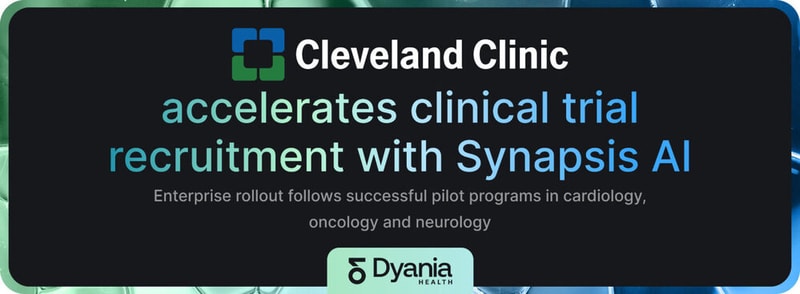
AI clinical recruitment is transforming how healthcare organizations identify patients for research studies and clinical trials. Cleveland Clinic partnered with Dyania Health to deploy medically trained large language models capable of analyzing medical records, clinical notes and imaging data to rapidly match patients with trial eligibility requirements. The Synapsis AI platform automates chart review processes that traditionally require extensive manual screening by healthcare professionals. In pilot programs, the technology demonstrated significantly faster patient identification speeds while maintaining clinical-grade accuracy across oncology and cardiology studies.
This AI-driven approach to trial recruitment could help pharmaceutical companies, hospitals and research institutions reduce enrollment delays that often slow medical progress. Healthcare organizations may increasingly adopt medically trained AI systems to streamline research operations, improve patient outreach and expand access to potentially life-changing therapies. The rise of automated clinical matching platforms also reflects growing demand for scalable healthcare infrastructure that can support faster research timelines, broader patient representation and more data-driven clinical decision-making.
Image Credit: Dyania Health
What's Driving This Trend
- Medically Trained Llms
- Medically trained LLMs that interpret clinical notes and imaging reveal the potential to dramatically shorten patient identification timelines while preserving clinical-grade accuracy.
- Automated Chart Review
- Automated chart review platforms that replace manual screening indicate opportunities to reduce bottlenecks in trial enrollment and reallocate clinical labor to higher-value tasks.
- Data-driven Patient Matching
- Data-driven patient matching across heterogeneous EHR and imaging sources suggests the ability to expand representative trial cohorts and accelerate study timelines.
Who This Affects Most
- Pharmaceutical R&D
- Pharmaceutical R&D stands to benefit from faster enrollment cycles and improved trial feasibility assessments enabled by scalable AI-driven recruitment capabilities.
- Academic Medical Centers
- Academic medical centers could leverage integrated AI matching to increase patient access to research opportunities and enhance institutional research throughput.
- Clinical Research Organizations
- Clinical research organizations may see platform-driven efficiencies in site selection and recruitment forecasting that change traditional vendor service models.