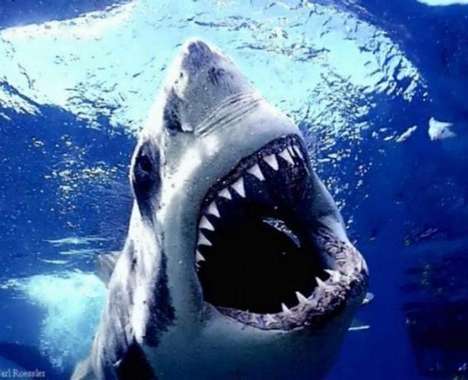

Pentagon scientists plan to use sharks as "stealth spies" capable of tracking vessels undetected.
Seriously. I'm not making this up.
British magazine The New Scientist reports that the scientists plan to control the sharks remotely by implanting electrodes in their brains. They will then "exploit sharks' natural ability to glide through the water, sense delicate electrical gradients and follow chemical trails."
According to the magazine, "...remote-controlled sharks do have advantages that robotic underwater surveillance vehicles just cannot match: they are silent, and they power themselves."
Still believe me? Yah? Then keep reading.
The project, which is funded by the Pentagon's Defence Advanced Research Projects Agency (DARPA), leverages brain implant technology that already allows scientists to control the movements of fish, rats and monkeys.
"Neural implants consists of a series of electrodes that are embedded into the animal's brain," states the magazine, "which can then be used to stimulate various functional areas."
The next step will be to release blue sharks with the implanted technology off the coast of Florida. Since radio signals cannot penetrate the sea, scientists will communicate with the sharks by sonar.
No plans have yet been revealed to implant these devices in human brains, although one has to wonder about the possibilities...
Key Themes Behind This Trend
- Remote-controlled Sharks
- Disruptive innovation opportunity: The use of remote-controlled sharks as surveillance vehicles offers a silent and self-powered alternative to robotic underwater vehicles.
- Implant Technology
- Disruptive innovation opportunity: Neural implant technology opens up possibilities for controlling the movements of various animals, potentially leading to new applications in research and surveillance.
- Underwater Communication
- Disruptive innovation opportunity: The development of communication methods, such as sonar, to interact with animals underwater can have applications beyond remote-controlling sharks, such as marine research and exploration.
Where This Applies
- Defense
- Disruptive innovation opportunity: Remote-controlled sharks can revolutionize underwater surveillance and reconnaissance capabilities in defense and military sectors.
- Biotechnology
- Disruptive innovation opportunity: Neural implant technology can drive advancements in biotechnology, enabling precise control of animals for research purposes and potentially leading to medical applications.
- Marine Exploration
- Disruptive innovation opportunity: Underwater communication methods, developed for remote-controlling sharks, can enhance marine exploration and research by enabling effective interaction with marine animals and environments.