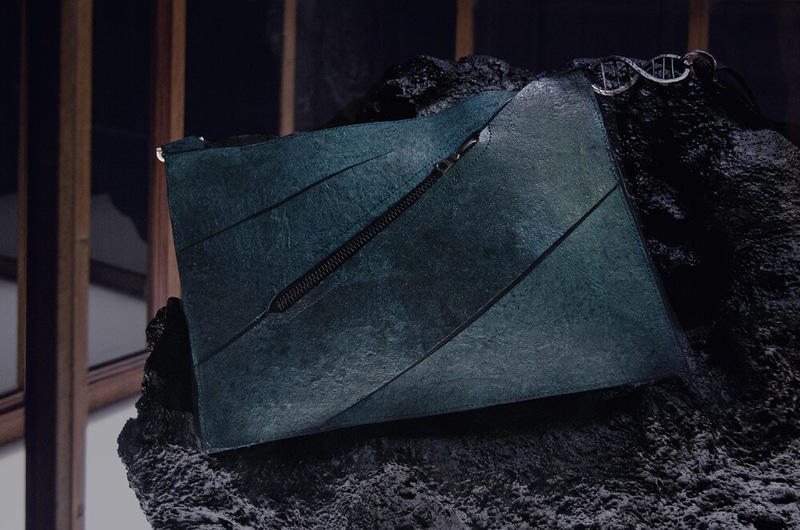
VML, in collaboration with The Organoid Company and Lab-Grown Leather Ltd., has unveiled the world's first product made from T-Rex Leather™ — a luxury handbag designed by the avant-garde techwear label Enfin Levé.
The handbag silhouette is surely a first in the world. It was created using reconstructed dinosaur collagen grown in a laboratory. No living animals were harmed in the process. The production process for the T-Rex Leather™ material begins with fossilized collagen sequences from an actual Tyrannosaurus rex, which scientists then complete using computational biology and AI modelling to synthesize a full DNA blueprint. Following this, billions of engineered cells are cultivated using a scaffold-free tissue platform to produce a durable, biodegradable, and fully traceable hide that is structurally identical to traditional leather.
Image Credit: VML
What Makes This Trend Stand Out
- Lab-grown Ancient Biomaterials
- Creates a new category of materials derived from reconstructed extinct-species proteins that challenge traditional notions of provenance and rarity in luxury goods.
- Dna-based Fashion Materials
- Uses computationally completed fossil DNA blueprints and cultured collagen to produce textiles with tunable mechanical and aesthetic properties previously unavailable to designers.
- Traceable Biodegradable Luxury Goods
- Combines full-chain traceability with scaffold-free tissue production to offer high-end products that are both biodegradable and verifiably authentic.
Sectors Adopting This
- Fashion & Luxury Accessories
- Faces the emergence of biologically engineered hides that could redefine value propositions around exclusivity, storytelling, and sustainable sourcing.
- Biotechnology & Synthetic Biology
- Houses capabilities for reconstructing ancient biomolecules and scaling cell-cultivation platforms that expand commercial applications beyond pharmaceuticals.
- Materials Science & Advanced Manufacturing
- Sees opportunities in adapting scaffold-free tissue fabrication and biomaterial characterization methods to create next-generation, performance-tuned surfaces.