






Universities of Heidelberg and Stuttgart Introduced a Conductive DLP
Edited by Debra John — March 4, 2026 — Tech
This article was written with the assistance of AI.
References: 3dprinting
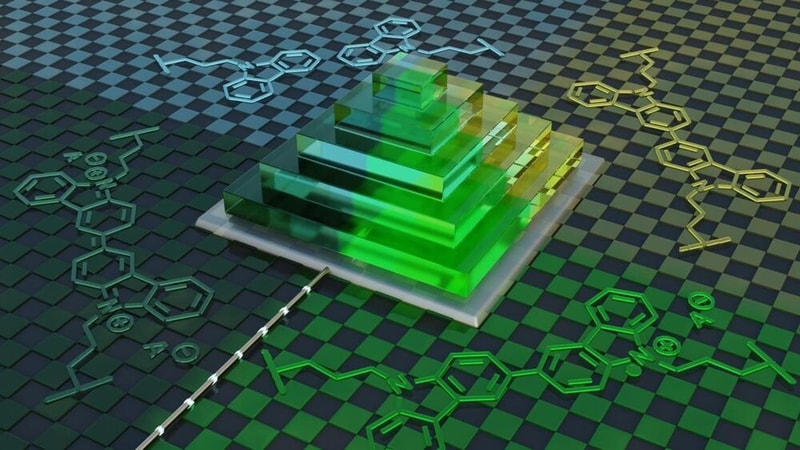
Researchers at the University of Heidelberg and the University of Stuttgart introduced a methacrylate-based conductive ink for digital light processing (DLP) 3D printing, featuring redox-active carbazole groups that enable electrochemical color changes. The teams used the formulation to print two-dimensional pixel arrays, checkerboard motifs and a multi-layered pyramid, demonstrating reversible color shifts under electrical stimulation.
The printed polymers switched from transparent to light green, dark green and black by toggling oxidation states; this control worked at the pixel level and through the structure’s height. The ink yields electrically conductive polymer networks compatible with high-resolution DLP workflows and was reported in Advanced Functional Materials as part of a German Research Foundation–backed project.
For consumers and manufacturers this material points to new pixelated displays, electrochromic interfaces and soft-robotic actuators with embedded circuitry and visual feedback. Its combination of fine DLP resolution and reversible redox-driven color control could simplify making integrated, responsive devices.
Image Credit: University of Stuttgart
The printed polymers switched from transparent to light green, dark green and black by toggling oxidation states; this control worked at the pixel level and through the structure’s height. The ink yields electrically conductive polymer networks compatible with high-resolution DLP workflows and was reported in Advanced Functional Materials as part of a German Research Foundation–backed project.
For consumers and manufacturers this material points to new pixelated displays, electrochromic interfaces and soft-robotic actuators with embedded circuitry and visual feedback. Its combination of fine DLP resolution and reversible redox-driven color control could simplify making integrated, responsive devices.
Image Credit: University of Stuttgart
Trend Themes
-
Pixelated Electrochromic Printing — A route toward embedding individually addressable color-changing pixels directly into DLP-printed parts, reducing reliance on separate display modules.
-
High-resolution Conductive Photopolymer Inks — A formulation that supports fine-feature conductive networks within photopolymer matrices, enabling circuitry and signal routing at DLP resolution.
-
Integrated Visual Feedback in Soft Materials — A foundation for soft robotic and flexible components that present localized electrochromic feedback through their structure rather than adding external indicators.
Industry Implications
-
Consumer Electronics — An opportunity for next-generation low-profile displays and interactive surfaces produced as single printed components with embedded, pixel-level electrochromic functionality.
-
Soft Robotics — A pathway to creating actuators and skins with built-in conductive networks and visual state indication, enabling more compact and responsive soft systems.
-
Medical Devices — A prospect for producing bespoke diagnostic or wearable devices that integrate conductive sensing and colorimetric readouts directly within biocompatible printed parts.
7.6
Score
Popularity
Activity
Freshness