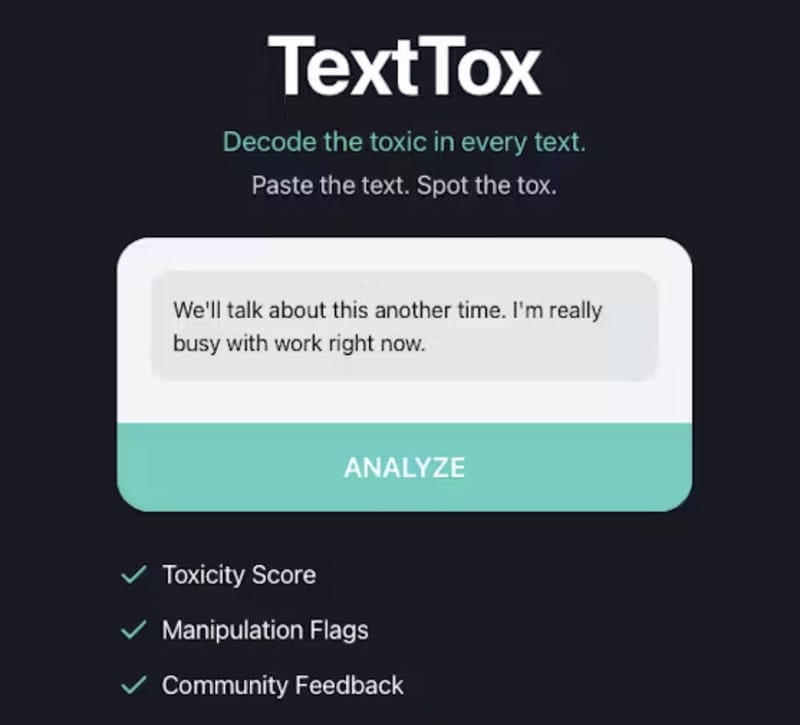
Text Tox is an AI-powered platform designed to analyze written messages for potential toxicity. Users can paste texts, including direct messages or emails, and the system evaluates them for indicators such as manipulation, dishonesty, ghosting, or gaslighting.
The analysis is grounded in natural language processing, allowing the platform to classify tones and intent within the text. By providing insights into the emotional or behavioral content of messages, Text Tox offers a digital perspective on interpersonal communication, highlighting patterns that might be difficult to interpret independently. Its interface is straightforward, allowing quick evaluation without complex setup. While positioned as a social and relational tool, the platform also illustrates broader applications of AI in sentiment analysis, text classification, and behavioral pattern recognition in digital communications.
Image Credit: Text Tox
What's Driving This Trend
- AI-powered Toxicity Detection
- High-accuracy toxicity labeling in everyday messages creates potential for new trust and safety layers within digital communication ecosystems.
- Behavioral Intent Classification
- The ability to infer manipulation, dishonesty, or gaslighting from text opens avenues for embedding psychological signal analysis into user-facing tools and analytics.
- Real-time Message Monitoring
- Instant evaluation of outgoing and incoming texts suggests opportunities for contextual moderation and risk scoring applied at the moment of communication.
Who This Affects Most
- Human Resources and Recruitment
- Automated analysis of candidate and employee communications could inform bias-detection, cultural-fit metrics, and early identification of workplace misconduct risks.
- Customer Support and Moderation
- Integrating message toxicity assessments into support channels may enable more nuanced prioritization and escalation of interactions based on emotional and behavioral signals.
- Dating Platforms and Social Apps
- Layering behavioral-intent insights onto user interactions could shift matching, safety features, and reporting mechanisms by surfacing relational risk indicators.