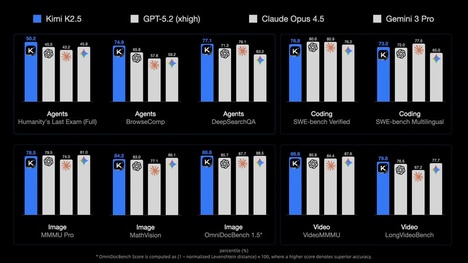

Moonshot AI, a Beijing-based lab founded by former Meta AI and Google Brain researcher Yang Zhilin, raised about $2 billion at a $20 billion valuation to expand its Kimi series of open-weight large language models, including the Kimi K2.6 model designed for broadly accessible inference. The funding round was led by Meituan’s Long-Z Investments and included participation from Tsinghua Capital, China Mobile and CPE Yuanfeng.
The company has scaled paid subscriptions and API usage, pushing annual recurring revenue above $200 million in April, while Kimi K2.6 became one of the most-used large language models on OpenRouter. Moonshot’s momentum follows growing investor interest in Chinese open-weight AI models alongside a wave of fundraising and public-market activity across rival AI labs.
For developers and businesses, the funding signals continued demand for lower-cost access to competitive LLM inference through open-weight releases, supporting wider experimentation and integration without reliance on expensive closed APIs. The deal also reflects a broader investment trend favouring distribution and developer adoption over proprietary ecosystem lock-in.
Image Credit: Shutterstock/Photo For Everything
Why This Trend Is Growing
- Open-weight Democratization
- Wider availability of open-weight models is lowering barriers to entry for organizations by enabling local inference and bespoke fine-tuning without dependence on proprietary APIs.
- Developer-centric Distribution
- Growing emphasis on subscriptions and API-first experiences is shifting competitive advantage toward platforms that prioritize developer adoption, extensibility, and low-cost scale.
- Capital-fueled Model Scaling
- Large funding rounds are accelerating rapid model development and deployment, creating pressure to optimize inference cost and delivery for mass-market use cases.
Industries Being Reshaped
- Cloud Infrastructure
- Edge and hybrid cloud providers face the prospect of commoditized inference workloads that demand novel pricing, hardware acceleration, and orchestration solutions.
- Enterprise Software
- Business application vendors are positioned to integrate customizable, locally hosted LLMs that could replace closed-model integrations and reconfigure SaaS value propositions.
- Telecommunications
- Network operators and telco cloud platforms may become key distributors of low-latency, on-premises LLM inference as demand for real-time, privacy-sensitive AI services grows.