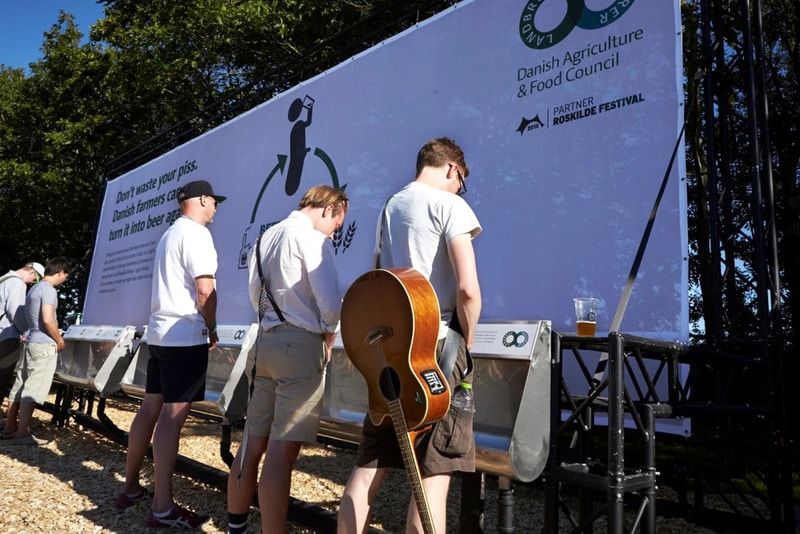
Roskilde Festival and the Danish Agriculture & Food Council introduced a beercycling initiative called From Piss to Pilsner that collected attendee urine, featuring dedicated urinals, storage tanks and P-Mate urine directors for female contributors. The scheme routed festival liquid waste to nearby farms so the nutrient-rich fluid could fertilize malting barley destined for beer production.
Organizers fitted strategically placed collection stations across the week-long event and coordinated transfers of stored urine to agricultural partners for field application. The program aimed to close a local-loop resource cycle by converting a plentiful waste stream into a crop input, with the harvested barley then used to brew beer for a future festival.
For consumers, the effort reframed festival waste as a tangible sustainability action that links attendee behavior to product outcomes, offering a memorable, low-tech example of circular resource use at large events.
Image Credit: Roskilde Festival
What's Driving This Trend
- Circular Festival Waste
- Demonstrates potential for events to transform onsite human waste into feedstock for local supply chains, enabling closed-loop production models that revalue previously discarded streams.
- Resource-efficient Event Design
- Highlights how integrating low-tech infrastructure like dedicated collection points and storage can shift event planning toward materials and nutrient conservation at scale.
- Participatory Sustainability Programs
- Shows that framing attendees as active contributors to product outcomes can create novel value propositions where consumer behavior directly funds and sources circular inputs.
Who This Affects Most
- Agriculture and Brewing
- Reveals opportunities for grain producers and brewers to source nutrient inputs from localized waste streams, shortening supply chains and differentiating products with traceable circular credentials.
- Waste Management and Logistics
- Points to demand for specialized collection, storage, and transfer systems that convert sanitary and organic waste into transportable agricultural inputs across urban-rural interfaces.
- Event Services and Experiences
- Indicates room for experiential programming and infrastructure providers to monetize sustainability storytelling by linking attendee participation to tangible ecosystem services and branded goods.