




Pacifico Energy Introduced the GW Ranch Project
Edited by Debra John — February 26, 2026 — Business
This article was written with the assistance of AI.
References: forbes
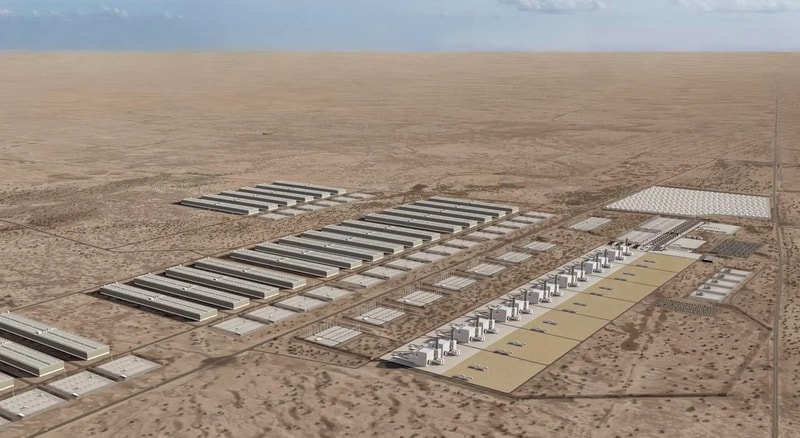
Pacifico Energy introduced its GW Ranch project, a proposed 8,400-acre off-grid power complex in Pecos County, Texas, designed to supply electricity to large AI data centers and hyperscalers, featuring gas turbines, 750 MW of solar and 1.8 GWh of battery storage.
CEO Nate Franklin secured emissions permits and has placed turbine orders while seeking about $12 billion in project financing. The plan called for up to 7.5 GW of gas-fired capacity that could power millions of homes or massive AI supercomputing facilities, and Pacifico positioned the site near the Waha gas hub to leverage low-cost natural gas.
By operating as a private grid disconnected from ERCOT, GW Ranch aimed to avoid transmission queues and distribution fees, offering potentially lower delivered power costs for data center customers and faster permitting. For AI operators and regional planners, GW Ranch signaled a trend toward dedicated, co-located energy campuses built to meet AI's concentrated power demands and to bypass grid constraints.
Image Credit: Pacifico Energy
CEO Nate Franklin secured emissions permits and has placed turbine orders while seeking about $12 billion in project financing. The plan called for up to 7.5 GW of gas-fired capacity that could power millions of homes or massive AI supercomputing facilities, and Pacifico positioned the site near the Waha gas hub to leverage low-cost natural gas.
By operating as a private grid disconnected from ERCOT, GW Ranch aimed to avoid transmission queues and distribution fees, offering potentially lower delivered power costs for data center customers and faster permitting. For AI operators and regional planners, GW Ranch signaled a trend toward dedicated, co-located energy campuses built to meet AI's concentrated power demands and to bypass grid constraints.
Image Credit: Pacifico Energy
Trend Themes
-
Off-grid Energy Campuses — Dedicated private grids co-located with hyperscale compute create a new model for vertically integrated power-and-data campuses that can bypass traditional transmission constraints.
-
Gas-solar Hybrid Microgrids — Combining multi-gigawatt gas turbines with hundreds of megawatts of solar and gigawatt-hours of storage produces dispatchable, low-cost baseload profiles tailored to continuous AI workloads.
-
Energy-as-a-service for Hyperscalers — Large-scale project financing and permit-backed capacity enable outsourced utility offerings that package generation, storage and grid independence into contracted services for cloud and AI operators.
Industry Implications
-
Data Center Infrastructure — Co-located off-grid power complexes reshape site selection economics and create opportunities for integrated power-optimized campus designs that reduce delivered energy cost and latency.
-
Distributed Power Finance — Multi-billion-dollar capital requirements and long-lived energy assets are driving the emergence of institutional investment vehicles and project finance structures specific to off-grid utility projects.
-
Natural Gas Supply and Trading — Proximity to major gas hubs and sustained large-volume offtake commitments are prompting novel contract structures and localized gas-to-power trading strategies that alter commodity risk profiles.
7.4
Score
Popularity
Activity
Freshness