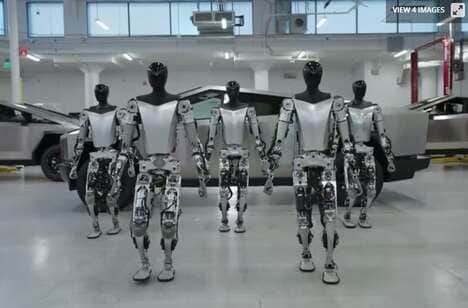
Transformer's have been a thing of science fiction until recently the shape shifting technology has been in development at the Carnegie Mellon University in Pittsburgh. The logic behind the technology is similar to the way ants act as a team to accomplish monumental tasks. Using swarms of microscopic robots that use electromagnetic forces to attract them together in hopes of assuming virtually any shape.
Head researcher, Seth Goldstein says that the final goal is still far from completion, but is still a big advancement in the field.
According to New Launches: “However, his team is using simulations to develop control strategies for futuristic shape-shifting, or "claytronic", robots, which they are testing on small groups of more primitive, pocket-sized machines. These prototype robots use electromagnetic forces to maneuver themselves, communicate, and even share power. Rob Reid at the US Air Force Research Lab is collaborating with the Carnegie Mellon team to develop even smaller prototype robots. Reid and colleagues can fold flat silicon shapes into 3D forms as little as a few hundred microns diameter. "We will drive those using electric forces too, by patterning circuits and devices into the silicon design," Goldstein says. He predicts that by the summer of 2008 they will have prototypes capable of rolling themselves around this way.â€â€
Once the development of this technology has been fully developed it will be interesting to see how they harness it possibly every day technology. Imagine how cool it would be to have a laptop that could transform into a cell phone, waffle maker, toaster, TV, DVD player: pretty much any gadget you could imagine.
Why This Trend Is Growing
- Shape-shifting Robots
- The development of shape-shifting robots using swarms of microscopic robots that use electromagnetic forces presents disruptive innovation opportunities for industries in manufacturing, construction, and healthcare.
- Claytronic Robots
- The development of futuristic claytronic robots capable of shape-shifting presents disruptive innovation opportunities for industries in electronics, consumer goods, and military technology.
- Electrically-driven Microrobots
- The development of electrically-driven microrobots capable of maneuvering themselves, communicating, and sharing power presents disruptive innovation opportunities for industries in nanotechnology, biotechnology, and transportation.
Industries Being Reshaped
- Manufacturing
- Shape-shifting robots can be used in manufacturing to carry out various tasks such as welding, inspecting, and assembling parts at a faster and more efficient rate.
- Construction
- Shape-shifting robots can be used in construction to help with tasks such as laying bricks, moving materials, and inspecting structures in a safe and cost-effective way.
- Healthcare
- Shape-shifting robots can be used in healthcare to carry out minimally invasive procedures, assist in surgeries, and deliver medicines to specific areas of the body.