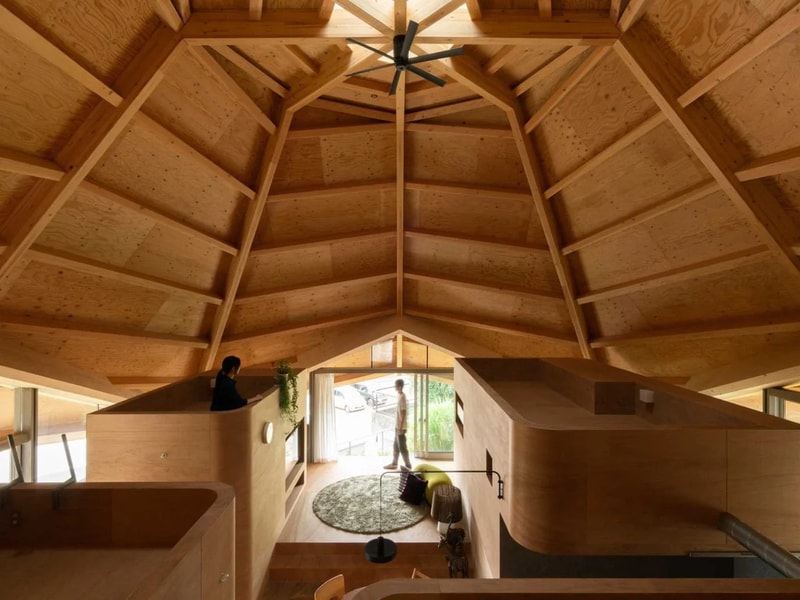
The UID Architects Spiderweb House is a private residence in Fukuyama, Japan that translates the structural logic of a spider's web into an open, adaptable family home. Positioned diagonally across its sloping site, the octagonal timber structure is defined by eight roof beams that converge at a glazed central oculus, bringing daylight into the heart of the interior while reinforcing the home's radial organization.
Spanning approximately 828 square feet, the layout replaces conventional rooms with four curved plywood volumes that loosely define living, dining, kitchen, and private areas without interrupting the openness of the space. The dining area occupies the center beneath the roof's structural hub, emphasizing shared family life as the focal point of the home.
The interior relies on exposed plywood as both its primary structural and finish material, creating visual continuity throughout the living spaces, while darker cabinetry distinguishes the kitchen without enclosing it. Split floor levels and movable furnishings further establish functional zones, allowing spaces to evolve as the family's needs change over time.
Image Credit: UID Architects
Why This Trend Is Growing
- Bio-inspired Housing
- Spiderweb geometry signals potential for residential designs that use natural structural systems to create distinctive, efficient, and emotionally resonant living environments.
- Adaptive Open-plan Living
- Flexible zones defined by curved volumes, split levels, and movable furnishings reflect a shift toward homes that evolve with changing family routines.
- Daylight-centered Design
- Central oculi and radial layouts present new possibilities for compact homes where natural light becomes both a spatial organizer and wellness-enhancing feature.
Industries Being Reshaped
- Residential Architecture
- Biomorphic structures and unconventional floor plans expand the market for custom homes that prioritize adaptability, openness, and site-responsive identity.
- Building Materials
- Exposed plywood and timber systems highlight demand for materials that serve simultaneously as structure, finish, and sustainable design statement.
- Interior Design
- Room-free spatial planning creates opportunities for interiors built around subtle zoning, multifunctional furniture, and continuous visual flow rather than fixed partitions.