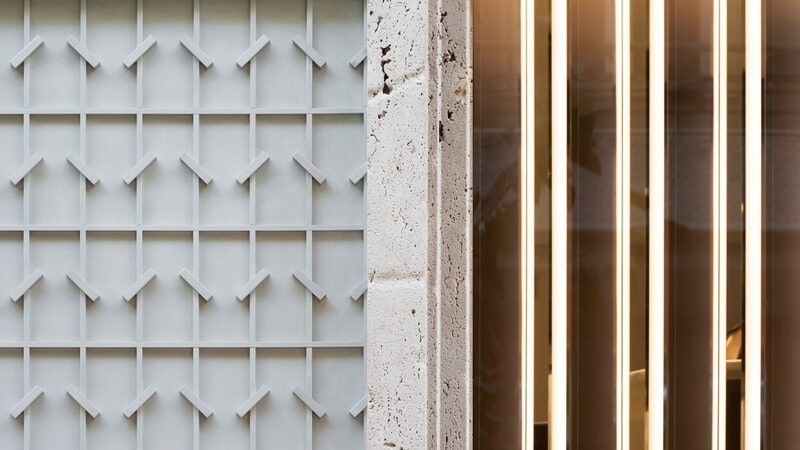
House of Nikos Koulis Athens transforms retail display into an architectural gesture by reimagining a mid-century storefront in upscale Voukourestiou Street as an evocative, rarely revealing façade. Designed by Bureau de Change, the design replaces typical full glazing with an irregular, sculpted window that offers fleeting glimpses of the interior.
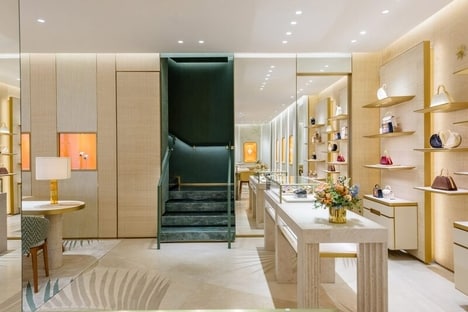
The surrounding facade references nearby ancient city walls through embossed aluminum panels that mimic the texture of 19th-century jewelry boxes, transitioning to travertine and marble at street level to frame a stone portal. A folded aluminum door handle inlaid with gold alludes to the fine craftsmanship inside, turning entry into an intimate experience. The space reflects the geometry and detail of Nikos Koulis’s structured jewelry. Silk-wall coverings offer a soft, light-reflective finish that contrasts sharply with custom dark-oak flooring made of narrow linear planks. At the rear, a hidden staircase behind bevelled glass leads visitors to a mezzanine jewelry salon.
Above, a sculptural screen of metal prisms—some reflective, some illuminated—filters light and views between the public ground floor and the private mezzanine. Display cases are crafted from lacquered wooden boxes on slender metal legs, blending vertical and horizontal compositions while leaving central circulation clear. House of Nikos Koulis Athens redefines how a luxury brand can merge history, craft, and spatial drama into one quietly theatrical retail experience.
Image Credit: Gilbert McCarragher
Why This Trend Is Growing
- Architectural Retail Displays
- Retail environments are evolving into architectural masterpieces, offering opportunities to redefine consumer experiences through unique design elements like sculpted windows and mirrored screens.
- Historical Aesthetic Integration
- Incorporating elements of historical architecture, like embossed facades and stone portals, is becoming a trend in luxury retail, enhancing brand storytelling through design.
- Material Contrast Design
- The strategic use of contrasting materials, such as silk and dark oak, is gaining traction for creating dynamic interiors that draw in and engage consumers.
Industries Being Reshaped
- Luxury Retail
- The luxury retail industry is witnessing a shift towards more integrated, architecturally engaging spaces that enhance brand narratives and consumer experiences.
- Architectural Design
- Architectural design firms are finding innovative opportunities in redefining traditional retail spaces with modern yet historically inspired elements.
- Interior Design
- There is a growing focus within the interior design industry on utilizing material contrasts to develop aesthetically striking and functionally cohesive retail environments.