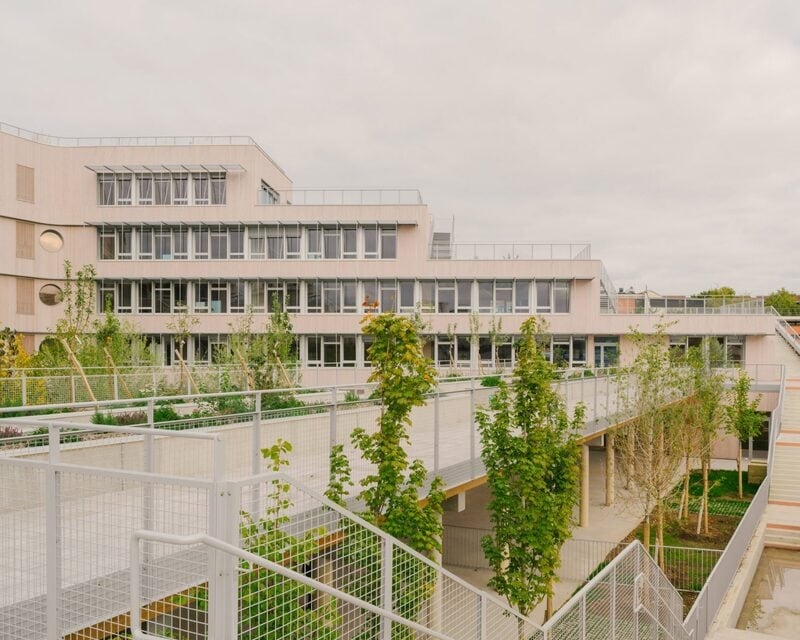
The Dominique Frelaut School Group is an educational complex designed by French architecture practice Tectoniques and located in Colombes, northwest of Paris. The project occupies a compact urban site and is organised as a vertical building arranged around a central playground. This configuration allows outdoor space to be positioned at the core of the school while accommodating a dense programme within a limited footprint. The building has a total floor area of approximately 5,180 square metres and brings together classrooms, circulation spaces and shared areas within a single continuous structure.
The façades facing the street are clad in vertically oriented terracotta plaquettes, referencing local brick architecture and creating a textured surface that shifts with light. Courtyard-facing elevations use timber elements combined with metal supports and planted vegetation. Circulation is organised through staggered floors and interconnected walkways, with several levels incorporating hanging garden balconies that extend teaching and recreation spaces outdoors.
Image Credit: Salem Mostefaoui
What's Driving This Trend
- Vertical School Complexes
- Compact multi-story school buildings centered on interior outdoor play spaces create potential for rethinking campus density and program integration in constrained urban lots.
- Centralized Playground Cores
- Organising outdoor recreation at the heart of a building encourages novel approaches to daylighting, supervision and mixed-use circulation that could redefine safety and social interaction standards.
- Terracotta-timber Hybrid Facades
- Combining terracotta cladding with timber elements and planted balconies points toward façade systems that integrate biophilic design, thermal performance and local material narratives.
Who This Affects Most
- Education Design
- School architects and planners confronting urban land scarcity may explore vertically oriented, mixed-program layouts that alter traditional classroom adjacencies and shared-space models.
- Urban Real Estate Development
- Developers working in dense municipalities could leverage vertically stacked institutional buildings to unlock higher-value parcels while accommodating public amenities within compact footprints.
- Building Materials Manufacturing
- Producers of cladding and structural components have opportunities to innovate modular terracotta and timber systems that balance aesthetics, maintenance and integration of greenery.