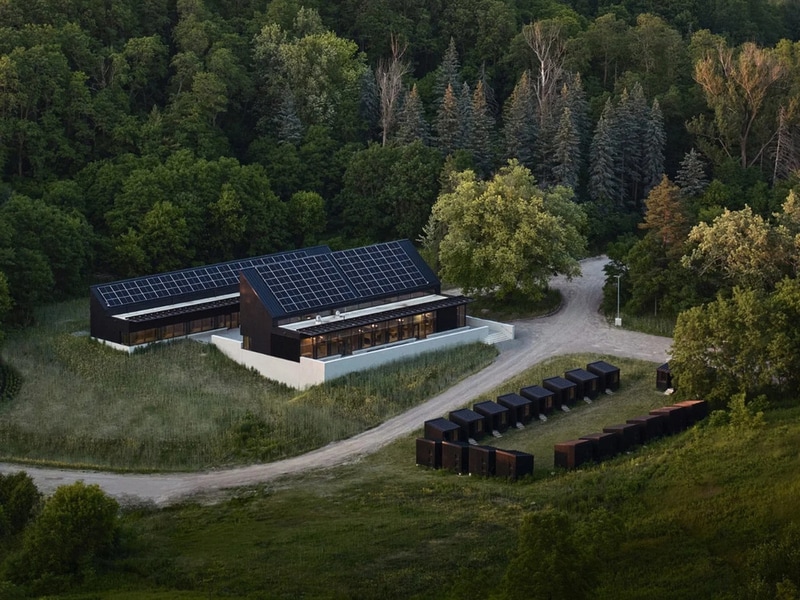
Koffler Scientific Reserve research building is a 2,680-square-metre facility designed by Montgomery Sisam Architects for the University of Toronto. Completed in 2025, the building serves as a research and teaching base for ecology and environmental biology within a 350-hectare site on the Oak Ridges Moraine. The program combines dormitories, classrooms, a dining hall, and shared living spaces into a single structure. Two angled shed roofs define the form and are positioned to optimize solar panel performance based on the site’s latitude.
The structure uses a hybrid system of mass timber and light-frame wood with glulam columns and beams supporting a tongue-and-groove roof. Exterior cladding is finished in shou sugi ban wood for durability and water resistance. A ground source heat pump circulates fluid through underground pipes to regulate heating and cooling. Solar panels and passive design strategies contribute to net-zero energy and carbon targets.
Image Credit: Montgomery Sisam Architects
Why This Trend Is Growing
- Net-zero Research Hubs
- Convergence of on-site renewable generation, ground-source heating and passive design creates models for research facilities that achieve net-zero energy and embodied carbon targets.
- Hybrid Mass-timber Construction
- The pairing of glulam framing with light-frame wood systems points to structural approaches that reduce embodied carbon while enabling larger, long-span institutional buildings.
- Integrated Living-learning Environments
- Combining dormitories, classrooms and communal amenities under a single envelope presents new opportunities for optimizing energy, social resilience and shared infrastructure in campus settings.
Industries Being Reshaped
- Sustainable Campus Design
- Academic institutions and master planners are increasingly prioritizing campus-wide strategies that balance pedagogy, stewardship and net-zero performance metrics.
- Renewable Energy Systems for Buildings
- Manufacturers and integrators of solar arrays and ground-source heat pumps are positioned to supply tailored, site-specific energy systems for carbon-neutral facilities.
- Prefabricated Mass Timber Manufacturing
- Producers of engineered timber components could scale panelized and modular offerings that accelerate low-carbon construction for institutional projects.