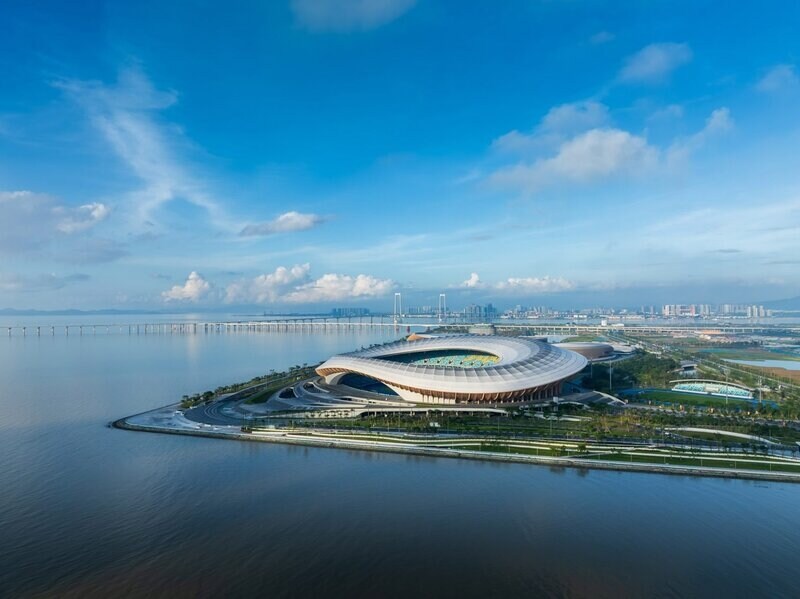
The Greater Bay Area Sports Centre by Zaha Hadid Architects spans 70 hectares and brings a full set of major sports facilities to Guangzhou’s Nansha district. The plan includes a 60,000-seat stadium, a 20,000-seat indoor arena and a 4,000-seat aquatics centre arranged within a landscaped site. The venues sit alongside training fields, outdoor courts and public parkland that link directly to the riverfront. Each building uses curved roof forms shaped to reduce heat gain and direct airflow across shaded spectator areas.
The complex is positioned as a year-round destination for both events and daily recreation. Circulation paths connect the three main venues with open plazas and green areas. The roofs and exterior cladding use layered geometries that echo local maritime forms while providing environmental control for the subtropical climate. The district is integrated with nearby transport links, so the sports centre functions as an anchor for the surrounding civic and residential development.
Image Credit: Seilaojiong
What's Driving This Trend
- Sustainable Architecture
- Curved roof forms and layered geometries in sports complexes highlight cutting-edge sustainable architectural practices that enhance environmental control.
- Multi-purpose Venues
- The inclusion of diverse facilities like stadiums, arenas, and aquatic centers showcases the growing trend of developing versatile, multi-functional urban spaces.
- Integrated Urban Development
- Developments like the Greater Bay Area Sports Centre are fostering a trend of integrating sports facilities within broader urban and residential planning, reinforcing civic engagement and lifestyle amenities.
Who This Affects Most
- Architecture and Design
- Large-scale sports complexes are driving innovation in architecture and design, focusing on sustainable materials and harmonious aesthetic integration with the natural environment.
- Sports and Recreation
- The rise of comprehensive sports centers is transforming the sports and recreation industry, offering expansive facilities that cater to both professional events and community engagement.
- Urban Planning and Development
- The emergence of sports complexes as anchors in urban landscapes signifies a shift in urban planning strategies, leveraging major facilities to enhance connectivity and community cohesion.