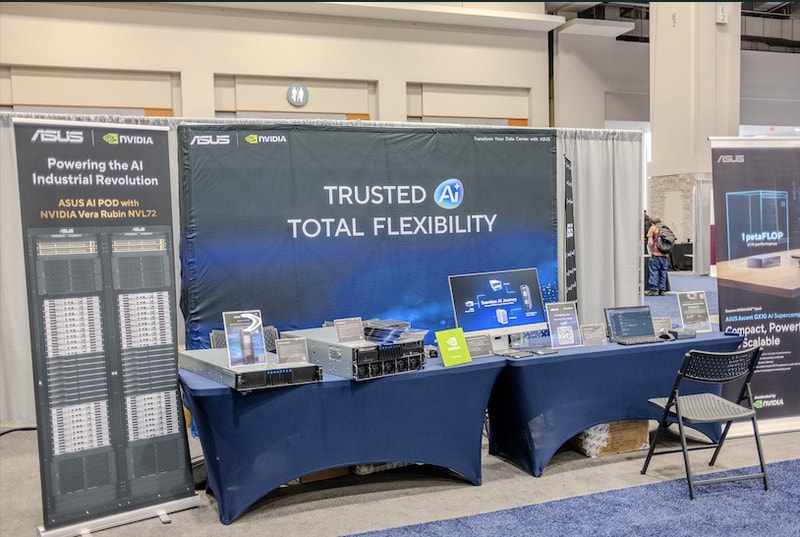
ASUS, a global technology company known for its computer hardware and servers, will present three enterprise AI infrastructure solutions at the AI+ Expo 2026 in Washington, D.C. All of the innovations are powered by NVIDIA technology and designed to handle large language models, generative AI, and high-performance computing tasks.
ASUS' ESC8000A-E13P, for example, is a high-density GPU server intended for AI training and deep learning. This technology can accommodate advanced GPU configurations with thermal management for sustained operation under heavy loads. The RS720A-E13-RS8G, on the other hand, is a two-unit server balancing performance and efficiency for AI inference, virtualization, and rendering workloads, while the Ascent GX10, built on the NVIDIA DGX Spark platform, is positioned as a turnkey appliance that brings supercomputing capabilities into a more accessible form factor. This latter innovation will appeal to organizations wanting to start AI initiatives without extensive custom engineering.
Image Credit: ASUS
Why This Trend Is Growing
- High-density GPU Server Adoption
- Rising deployment of compact, thermally optimized GPU clusters enables organizations to train larger language models with reduced rack footprint and sustained performance under continuous workloads.
- Turnkey Supercomputing Appliances
- Preintegrated DGX-based appliances are lowering barriers to entry by delivering near-supercomputer performance in a packaged form factor that minimizes systems integration and tuning.
- Performance-efficiency Hybrid Servers
- Balanced two-unit server designs are converging high-throughput inference and energy-aware operation to support mixed workloads like virtualization, rendering, and real-time AI inference.
Industries Being Reshaped
- Cloud Service Providers
- Hyperscalers and regional cloud operators stand to reshape service tiers through denser GPU provisioning that changes pricing models and SLAs for AI training and inference.
- Healthcare and Life Sciences
- Clinical research and medical imaging workflows could leverage turnkey AI appliances to perform complex model training and inference without requiring in-house supercomputing expertise.
- Financial Services and Trading
- Latency-sensitive trading algorithms and risk simulations may be transformed by compact, high-performance GPU infrastructure that accelerates model retraining and real-time analytics.