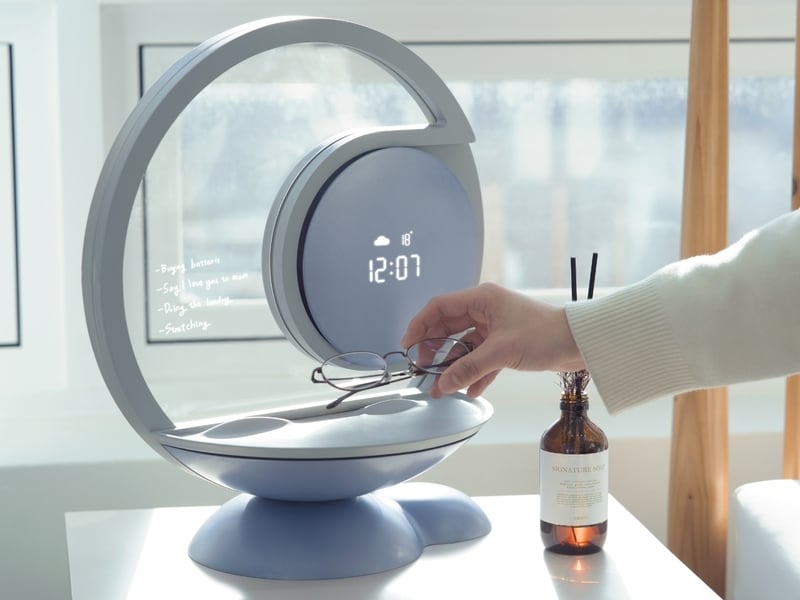
The Darling concept is a bedside lamp designed to help users remember essential items during morning routines. The object uses proximity sensing to register items such as keys, glasses, or a phone when they are placed near its base. If the user begins to leave the room without one of the registered objects, the lamp provides a visual or auditory alert to signal that something is missing. The reminder system is intended to operate passively without requiring daily input once items are registered.
In addition to its tracking function, the lamp serves as a standard ambient light source with adjustable brightness for bedside use. Touch-based controls allow users to manage light levels and reminder settings directly on the device. Wireless connectivity enables synchronization with a mobile device for notifications and configuration. The form is compact and minimal, allowing the lamp to sit on a bedside table without additional accessories or visible hardware.
Image Credit: YeEun Kim
What's Driving This Trend
- Ambient Object Tracking
- Embedding proximity sensing into everyday fixtures creates opportunities for unobtrusive item-presence awareness that reduces cognitive load during routines.
- Passive Routine Automation
- Systems that learn and operate without daily user input enable seamless habit support and low-friction reminders integrated into day-to-day objects.
- Converged Lighting-reminder Devices
- Combining ambient illumination with contextual alerts opens avenues for multifunctional devices that replace separate trackers, lamps and notification hubs.
Who This Affects Most
- Consumer Electronics
- Demand for compact, minimal devices presents scope for new product categories combining sensors, connectivity and tactile controls in bedside and personal gadgets.
- Smart Home
- Home automation platforms can be extended with localized presence-aware peripherals that enrich room-level intelligence and contextual scene management.
- Healthcare and Elder Care
- Passive monitoring of essential-item use and departure cues offers potential for non-intrusive support tools that assist memory-impaired or mobility-challenged individuals.