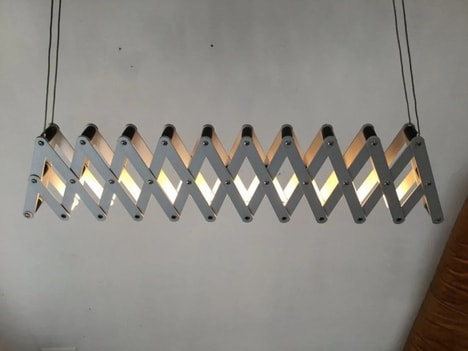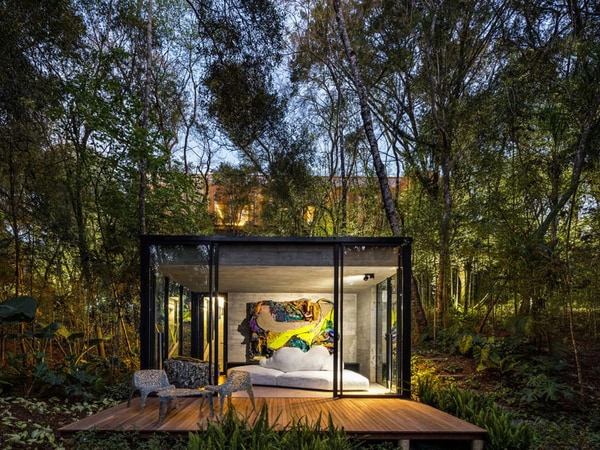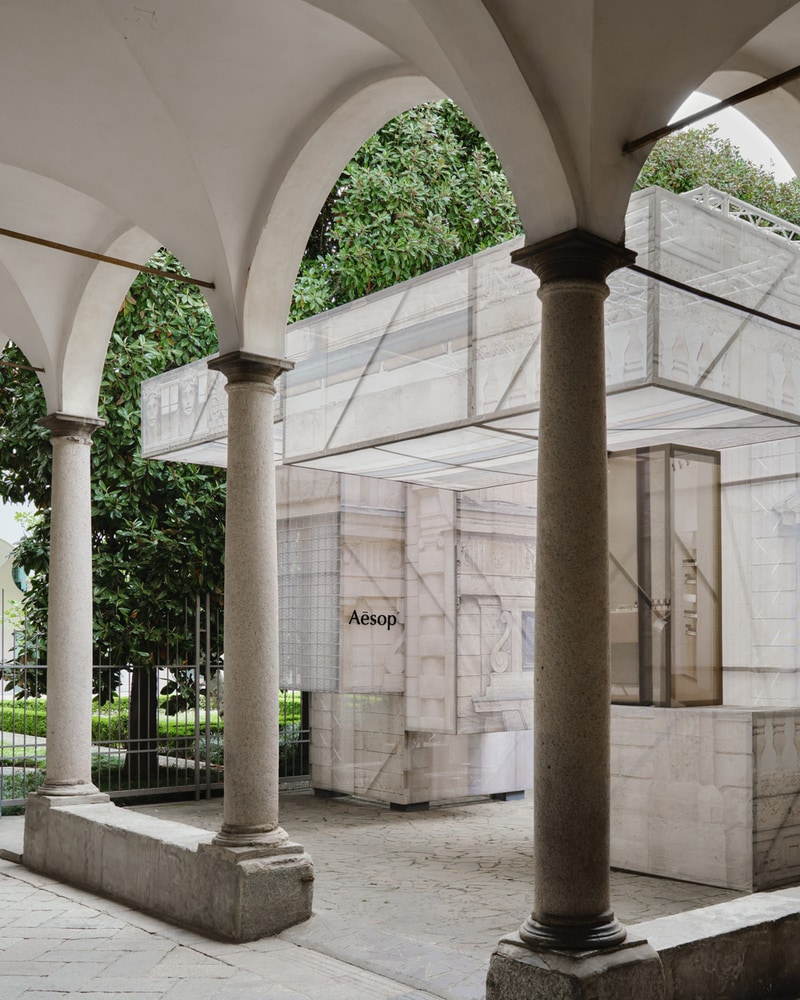
The Aesop Aposē lighting collection is presented within “The Factory of Light,” an installation staged at the cloister of Santa Maria del Carmine in Milan from April 21 to April 26, 2026. The project is designed by architect Rodney Eggleston and constructed using reclaimed scaffolding and trompe-l’œil tarpaulin materials, forming a translucent architectural structure. Visitors move through a sequence of rooms that explore light through filtered, reflected, and diffused conditions across the space.
The installation includes a sacristy space featuring an arrangement of approximately 10,000 perfume bottles, creating reflective surfaces that interact with the lighting environment. Within this setting, the Aposē lamps are introduced as a trio of lighting pieces integrated into the installation. One version of the lamp is produced as a limited edition, with the collection positioned alongside objects and formulations displayed throughout the exhibition environment.
Image Credit: Ludovic Balay
What's Driving This Trend
- Reclaimed-material Installations
- Use of reclaimed scaffolding and trompe-l’œil tarpaulin indicates a shift toward low-carbon, aesthetically rich structures that reconfigure waste streams into premium exhibition architecture.
- Light-focused Spatial Narratives
- Staged sequences of filtered, reflected, and diffused light reveal emerging practices where illumination becomes the primary medium for storytelling and spatial differentiation.
- Product-integrated Exhibitions
- Placement of Aposē lamps amid thousands of perfume bottles highlights a trend of embedding products directly into immersive contexts to blur boundaries between display, demonstration, and desirability.
Who This Affects Most
- Exhibition Design
- Curatorial approaches that combine salvaged materials with engineered lighting suggest new service models centered on itinerant, modular exhibitions optimized for rapid deployment and high visual impact.
- Lighting Design
- Integration of sculptural lamps within atmospheric installations points to opportunities for designers to develop context-aware luminaires that prioritize experiential effects over pure illumination metrics.
- Luxury Goods Retail
- Presenting limited-edition objects inside theatrical installations signals a retail transformation where experiential provenance and narrative-rich settings become key vectors of perceived value.