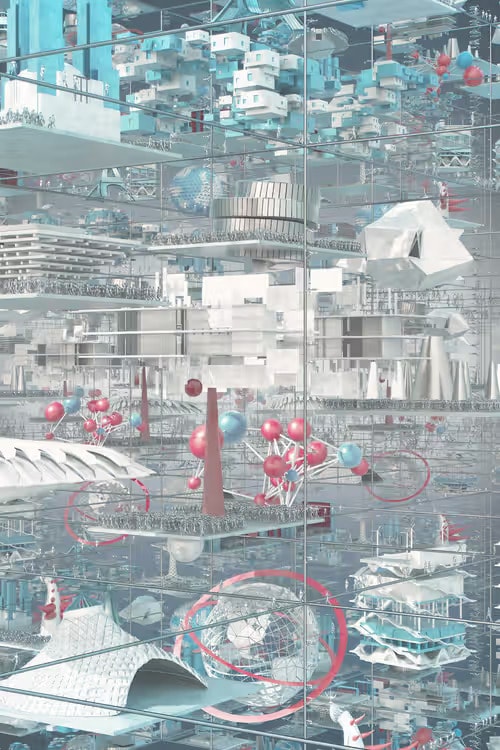
After Utopia is a three-channel video installation by Marco Brambilla that reconstructs 135 years of world’s fairs inside a single continuous digital landscape. The work combines AI-generated crowd data, archival references, and computer graphics to rebuild major expo pavilions from events spanning Paris 1889 to Osaka 2025. These structures are stacked and layered into a tall vertical panorama where historic architecture appears as one seamless environment rather than separate sites. The virtual city is populated with crowds modeled from attendance records to create movement through the merged expo zones.
The installation positions the fairs as collective visions of progress by removing their geographic and chronological distances. The vertical format emphasizes scale and gives the viewer a sense of rising through different eras while remaining inside one uninterrupted frame. The piece is exhibited across large screens in a gallery setting and uses detailed textures and lighting to blend the reconstructed buildings into a cohesive digital world.
Image Credit: The Foldsonian Flu, Marco Brambilla
What Makes This Trend Stand Out
- Virtual Reality Expo Experiences
- By reconstructing historical world's fairs as immersive digital environments, creators can offer audiences an innovative way to explore cultural heritage in a fully virtual setting.
- AI-driven Historical Recreation
- Employing AI to generate accurate crowd simulations and digital reconstructions of past events allows for the creation of dynamic educational tools that bring history to life in unprecedented ways.
- Seamless Digital Environments
- The integration of diverse architectural styles into a singular virtual cityscape highlights opportunities for developing comprehensive digital spaces that blend historical and modern aesthetics.
Sectors Adopting This
- Digital Art Installations
- The fusion of AI, crowd data, and computer graphics in video installations can redefine public art by creating interactive and large-scale digital exhibits.
- Educational Technology
- The blending of historical and modern contexts in a virtual setup points to new possibilities for educational platforms that engage users through immersive storytelling.
- Event Simulation Software
- Technological advancements in virtual reconstructions could revolutionize how event planners visualize and plan large-scale gatherings by simulating complex environments.