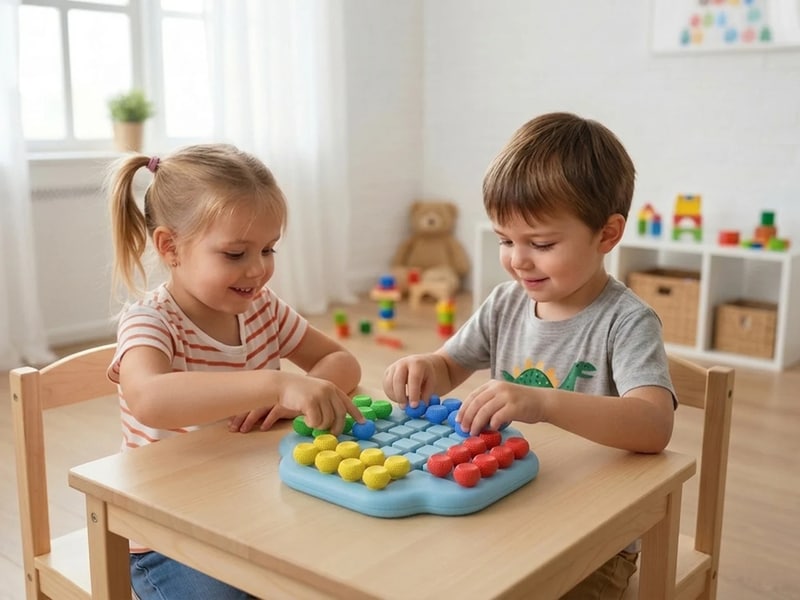
Toddler Plus board game is a concept game designed by Adesh Jadhav for children aged four to six that introduces basic logic before traditional gameplay begins. The game replaces dice rolling with hands-on interaction, where players slide colored pegs along fixed pathways on the board. Movement is constrained by obstacles, requiring players to shift other pieces first to clear a route. This structure introduces cause-and-effect thinking and sequencing through physical interaction rather than instructions or rules-based turns.
The board uses guided tracks that direct peg movement across the surface, with each color assigned to a specific destination corner. Players navigate pieces around blockages by repositioning other pegs within the system. The game supports both solo and multiplayer use, with one player solving the board independently or multiple players taking turns within the shared layout. The construction relies on a fixed board with integrated pathways and movable peg elements.
Image Credit: Adesh Jadhav
Key Themes Behind This Trend
- Tactile-first Learning
- A shift toward hands-on interfaces that teach cognitive skills through touch and manipulation rather than screens, enabling new forms of embodied sequencing and problem solving.
- Sequence-based Gameplay
- Games that embed cause-and-effect and stepwise reasoning into core mechanics create learning experiences where logical ordering is learned through play.
- Modular-pathway Interfaces
- Fixed boards with integrated tracks and movable elements surface as adaptable platforms that can represent procedural flows and scaffold progressively complex tasks.
Where This Applies
- Educational-technology
- Physical-digital hybrids that combine sensorized boards with learning analytics offer alternative assessment models focused on process-oriented skills.
- Toy-manufacturing
- Durable, integrated-pathway playsets that prioritize constrained movement and interdependency open opportunities for new product lines centered on developmental sequencing.
- Early-childhood-education
- Classroom practice that incorporates tactile sequencing tools provides observable milestones in executive function and procedural thinking for early learners.