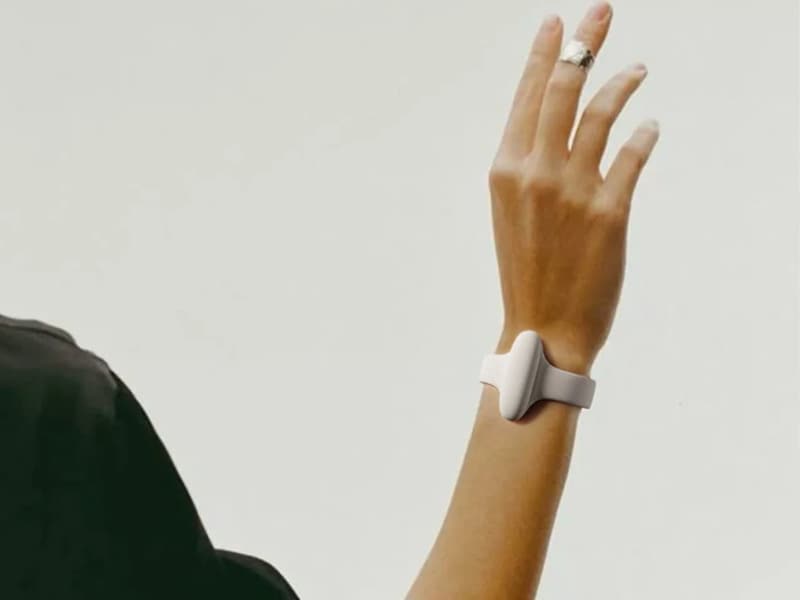
The NURA bracelet by Samuel Nagel and Paul Feiler rethinks accessibility through a wearable device that translates sign language into spoken language. The concept uses EMG (electromyography) sensors placed around the wrist and forearm to detect muscle activity as the wearer signs. These signals are interpreted and converted into speech output, allowing communication to happen without an interpreter or separate interface. The device also works in reverse, translating spoken language into written text to support two-way interaction.
The design integrates additional contextual sensing through facial expression analysis to improve accuracy and meaning during conversations. Rather than positioning itself as medical equipment, the bracelet is designed as a refined, wearable object that resembles a contemporary accessory. Its form prioritizes everyday wearability, reducing the stigma around assistive technology.
Image Credit: Samuel Nagel, Paul Feiler
What Makes This Trend Stand Out
- Wearable Sign-to-speech Devices
- A new class of wrist-worn devices transforms hand and arm movements into natural spoken output, enabling seamless conversational exchange without human intermediaries.
- Emg-based Gesture Recognition
- Muscle-signal sensing around the forearm is enabling precise interpretation of subtle gestures, expanding the expressive bandwidth of nonverbal input for machines.
- Fashion-forward Assistive Technology
- Assistive devices are being reconceived as everyday accessories, combining refined aesthetics with sensing capabilities to reduce stigma and increase adoption.
Sectors Adopting This
- Hearing and Speech Healthcare
- Clinical services and therapeutic tools stand to be reshaped by portable translation wearables that provide real-time communication support outside traditional care settings.
- Consumer Electronics
- Mass-market wearable manufacturers could integrate advanced biosensors and on-device processing to deliver multimodal interaction experiences in compact form factors.
- Education and Accessibility Services
- Learning environments and accessibility platforms may be altered by personal translation wearables that enable equitable participation for students who use sign language.