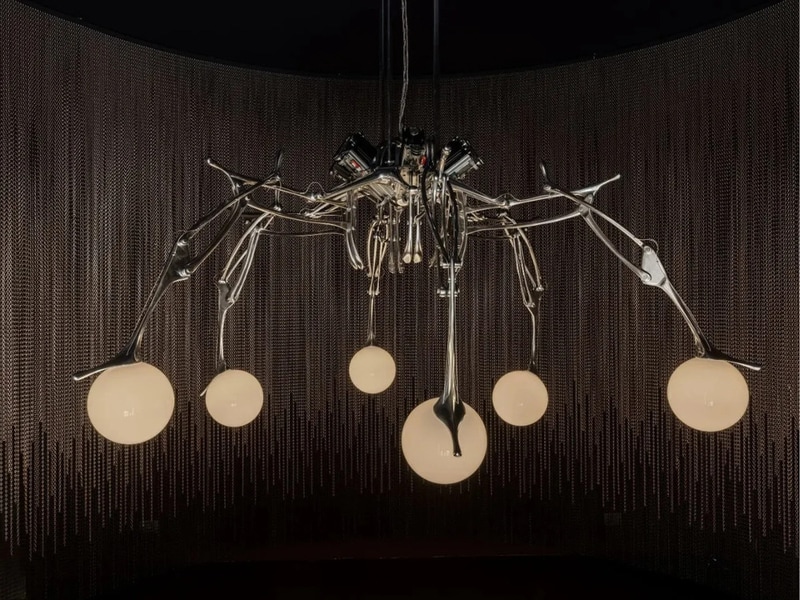
The LUMIAC chandelier by Andrea Mancuso reframes lighting through early computational logic. Its name, Light Unit Mechanized Intelligence Apparatus Computer, references the MANIAC computer from the 1950s, positioning the work as a conceptual bridge between machine systems and spatial design. The piece treats illumination as an active, structured process rather than a static decorative object, where light operates as a controlled and evolving system within space.
Presented during Milan Design Week 2026, the installation is staged within a layered environment created using Kriskadecor’s aluminium chain curtains. These semi-transparent metallic veils function as spatial filters that modulate visibility and guide movement around the chandelier. The lighting interacts with these surfaces, generating shifting reflections and diffused gradients across the installation.
Image Credit: Andrea Mancuso
Key Themes Behind This Trend
- Computational Lighting Systems
- Emerging use of algorithmic control in luminaires that treats illumination as a programmable, time-based system capable of creating dynamic spatial narratives.
- Adaptive Spatial Fabrics
- Semi-transparent metallic veils and chain curtains functioning as responsive filters that modulate light, sightlines, and perceived room volume.
- Kinetic Reflective Installations
- Moving or layered reflective surfaces producing shifting gradients and complex light scattering that redefine ambient perception and material expression.
Where This Applies
- Architectural Lighting
- Integration of computational control and spatial choreography in fixtures that can transform building interiors into programmable experiential zones.
- Interior Design and Partition Systems
- Use of decorative yet functional partitions that act as both aesthetic elements and environmental modulators within commercial and residential spaces.
- Smart Building Materials
- Materials engineered to interact with light and movement, offering surfaces that adapt visually and sensorily to occupant behavior and environmental conditions.