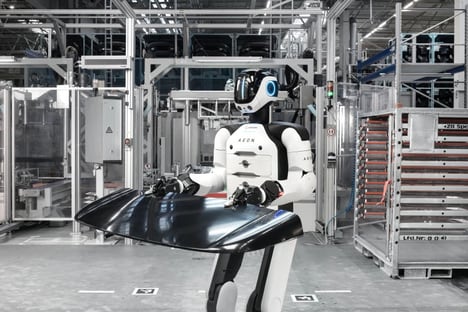
As the capacities of AI robotics expand, what many people are hopeful about is a solution that can take on tedious, draining tasks and give them back time for the things that actually matter—and Helix 02 by Figure, the AI robotics company's most capable humanoid model to date, can now clean the living room.
Touching on some of the challenges of making whole-body, end-to-end living room cleanup possible, Figure said, "But from a robotics perspective, this task is incredibly difficult. Unlike more structured commercial tasks, a living room changes constantly. Objects are scattered unpredictably. Furniture creates narrow navigation paths. Soft items like towels and pillows behave dynamically." Helix 02 can now use a spray bottle to wet a dirty surface and wipe the surface, toss pillows back onto the couch, reorient remotes, reorganize tools in motion, and more.
What Makes This Trend Stand Out
- Domestic Robotics Adoption
- Growing acceptance of humanoid cleaners points to new household service models that replace repetitive manual chores with autonomous systems.
- Adaptive Manipulation
- Advances in compliant grippers and dynamic object handling enable robots to interact reliably with soft, irregular, and moveable items in unstructured environments.
- Perception-driven Navigation
- Improved scene understanding and real-time mapping allow machines to traverse cluttered, reconfigurable living spaces while avoiding delicate objects and narrow passages.
Sectors Adopting This
- Home Cleaning Services
- Automated humanoid cleaners could transform business models from hourly labor to on-demand robotics subscriptions with remote monitoring and scheduling.
- Consumer Electronics
- Integrating advanced sensors, actuation, and AI into household robotics creates opportunities for modular, upgradeable devices that converge smart-home ecosystems.
- Elder Care and Assisted Living
- Robots capable of tidying, object retrieval, and gentle manipulation may change daily assistance paradigms by supporting independence and reducing caregiver strain.