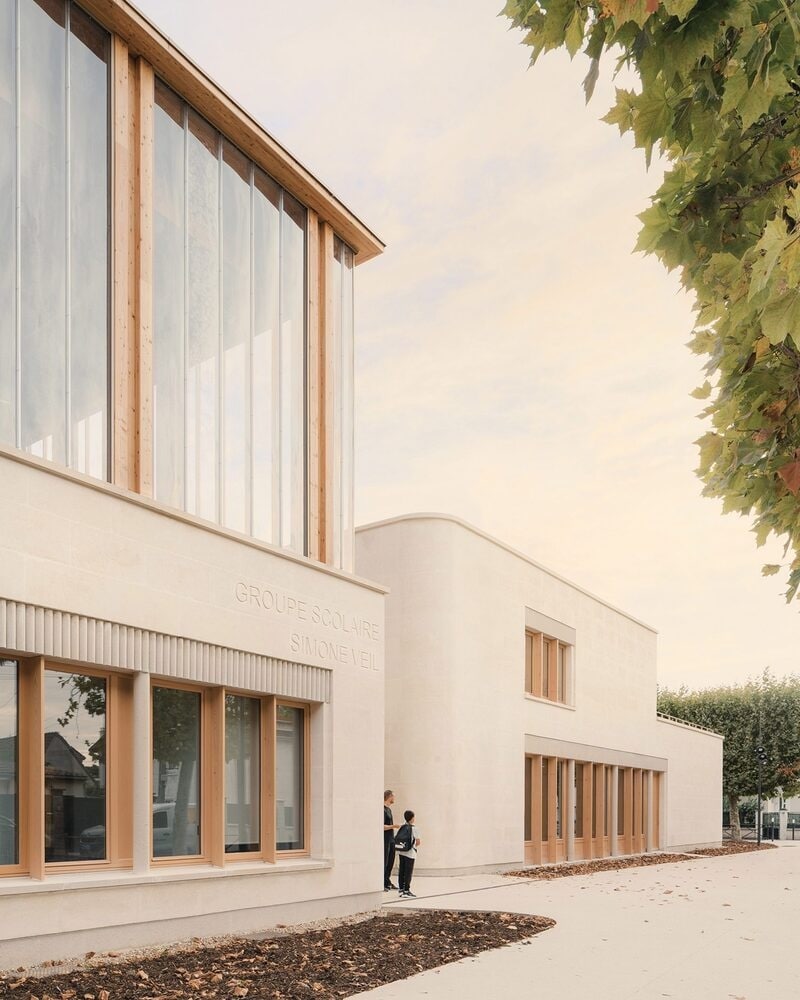
Groupe scolaire Simone Veil by Le Penhuel Associés is a new school campus in Meudon-la-Forêt, France that rethinks the architecture of education through interconnected volumes and purposeful spatial sequencing. The design organizes classrooms, communal facilities, and outdoor spaces into a series of layered forms that respond to both natural light and site context.
The campus plan positions primary learning spaces to receive morning light while grouping communal functions and circulation paths around a central courtyard that serves as an outdoor gathering zone. Classroom wings are articulated as horizontal slabs, with deep roof overhangs and recessed openings that provide shading, daylight control, and visual connection with planted landscapes. Circulation corridors are treated as transitional zones that visually engage with outdoor courtyards, encouraging movement and a sense of openness throughout the campus.
Image Credit: Vladimir de Mollerat du Jeu
What Makes This Trend Stand Out
- Daylight-driven Learning Design
- Classroom orientations and deep overhangs that optimize morning light and daylight control enable new lighting-responsive pedagogy and sensor-integrated learning environments.
- Layered Modular Campus Planning
- Interconnected horizontal slabs and sequenced volumes create opportunities for prefabricated modular assemblies that redefine scalability and customization of school campuses.
- Indoor-outdoor Transitional Circulation
- Circulation corridors that visually and physically engage courtyards suggest hybridized circulation zones combining social, climatic, and teaching functions.
Sectors Adopting This
- Educational Architecture
- Design practices focused on school typologies can be transformed by integrating environmental psychology, flexible spatial programming, and systems thinking into standard briefs.
- Building Materials and Façade Systems
- Advanced shading, recessed-opening systems, and lightweight prefabricated façades open possibilities for adaptive envelope products tailored to temporal daylight and thermal control.
- Landscape Architecture and Urban Design
- Courtyard-centered campus plans point toward integrated landscape-infrastructure solutions that merge stormwater management, outdoor pedagogy, and microclimate modulation.