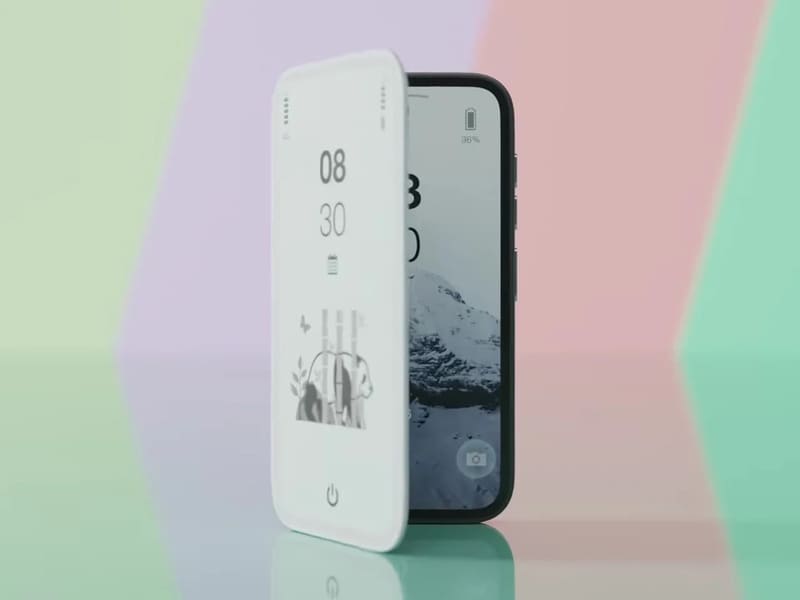
This E Ink flip case is a concept phone accessory designed by Pixel Dynamics that places a low-power display on the outer cover. The case uses an E Ink panel to show information such as the time, date, battery level, and signal status while the phone remains closed and locked. The display only consumes power when the image changes, allowing it to remain visible throughout the day without continuous battery drain.
The case attaches using a MagSafe-style magnetic system and draws power through contact pins connected to the phone, removing the need for a separate battery. Data transfer between the case and device is handled through a concept system referred to as Laser-Link, which replaces wireless protocols with a direct optical connection.
Image Credit: Pixel Dynamics
Why This Trend Is Growing
- Low-power Always-on E-ink Accessories
- A persistent, ultra-low-energy external display approach that enables continuous glanceable status without waking the host device, reducing overall power draw and increasing ambient utility.
- Magnetic Power-through Case Systems
- Accessory designs that draw power directly from the phone through magnetic attachment and contact pins, enabling battery-free peripherals with seamless physical integration.
- Optical Data Transfer for Peripherals
- Direct line-of-sight optical links between device and case that replace RF protocols, offering lower latency, reduced interference, and novel security or bandwidth characteristics.
Industries Being Reshaped
- Mobile Accessories
- Peripheral makers are positioned to redefine value propositions by embedding low-energy displays and integrated power/data connections into cases and covers.
- Smartphone Manufacturing
- Phone OEMs could incorporate standardized contact interfaces and magnetic coupling features to support a new ecosystem of power-through, optically linked add-ons.
- Wearable and Ambient Displays
- Producers of wearables and ambient information devices may leverage E Ink panels and optical coupling to create unobtrusive, always-on status surfaces that extend device functionality.