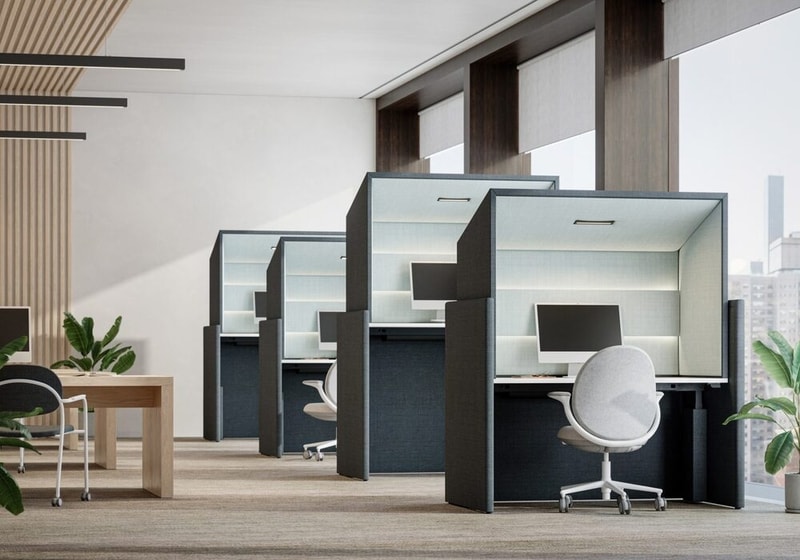
The Canopy workstation by Gensler and KFI Studios is a freestanding workstation designed for open-plan office environments. It features a defined architectural structure intended to create individual work zones within shared spaces. The design includes an upholstered privacy hood that forms an enclosed upper section around the user’s workspace.
The workstation incorporates integrated lighting within the hood and includes a height-adjustable work surface. It is designed to support focused work, video calls, and general office tasks while remaining part of an open layout. The system also includes integrated power access, including USB ports. Optional occupancy sensors are available to control lighting when the workstation is not in use. The lower structure can be finished in upholstery, FSC-certified red oak veneer, or low-VOC laminates.
Image Credit: Gensler
Why This Trend Is Growing
- Adaptive Privacy Hoods
- Customizable upholstered hoods with integrated lighting and sensors present opportunities for reimagining individualized acoustic and visual privacy within open-plan offices.
- Integrated Workstation Electronics
- Built-in power, USB ports, and occupancy-aware lighting signal a shift toward embedded electronics platforms that standardize connectivity and smart energy management at the furniture level.
- Material-transparent Sustainability
- Use of FSC-certified wood veneers and low-VOC laminates highlights demand for traceable, health-conscious materials that can disrupt supply chains and certification-driven procurement.
Industries Being Reshaped
- Commercial Office Furniture
- Freestanding modular workstations suggest potential to transform product lines toward configurable, technology-enabled units that compete with traditional desking systems.
- Smart Building Technology
- Furniture with sensors and integrated lighting indicates possibilities for workstations to function as decentralized nodes in building automation and occupancy analytics networks.
- Corporate Real Estate Design
- Architectural workstations that carve individual zones within open plans point to new paradigms for space planning that balance density with defined privacy.