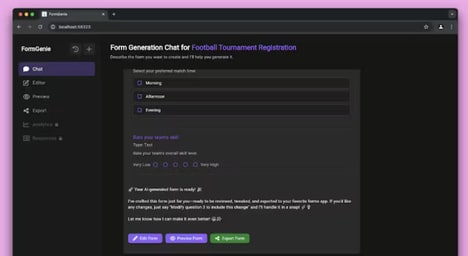
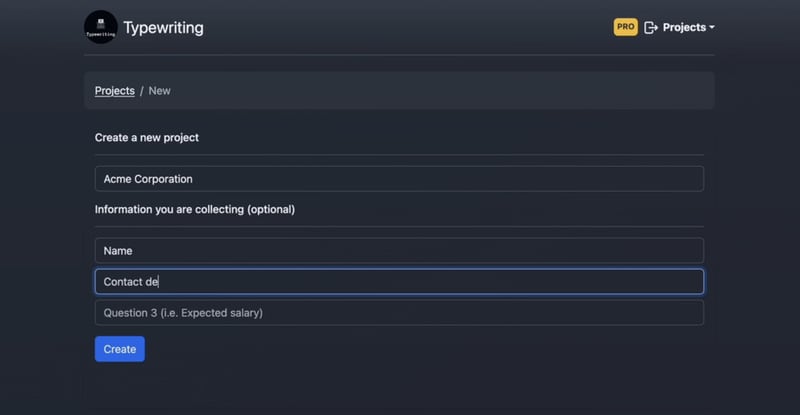
Typewriting positions itself within the conversational interface and customer experience space, aiming to replace traditional static forms with dynamic, AI-driven interactions. Instead of requiring users to complete predefined fields, it gathers information through dialogue, asking follow-up questions and clarifying responses in real time.
This approach allows businesses to capture more nuanced input while guiding users through complex topics or services. It is designed for scenarios where understanding intent is as important as collecting structured data, such as onboarding, feedback, or lead qualification. Its value lies in improving completion rates and user engagement by making interactions feel more natural and adaptive. Its effectiveness will depend on conversational accuracy, handling of edge cases, and how well it structures collected data for downstream use without losing clarity or consistency.
Image Credit: Typewriting
What Makes This Trend Stand Out
- Adaptive Conversational Interfaces
- Interfaces that evolve questions based on prior answers enable more precise intent capture and richer contextual data than static forms.
- Contextual Follow-up Logic
- Dynamic follow-up questioning and clarifications reduce ambiguity and surface edge-case information that traditional field-based forms typically miss.
- Structured Data From Natural Language
- Real-time extraction and normalization of structured fields from freeform conversational responses allow downstream systems to ingest nuanced inputs without manual mapping.
Sectors Adopting This
- Financial Services
- Conversational intake for onboarding and KYC can reveal intent signals and layered risk indicators that static questionnaires often overlook.
- Healthcare and Telemedicine
- Patient triage and intake via AI-driven dialogues can capture symptom narratives and clarifying details that improve diagnostic routing and care plans.
- Saas Customer Experience Platforms
- Embedding conversational form tools into product flows can surface usage intent and friction points in real time, informing personalization and product adjustments.