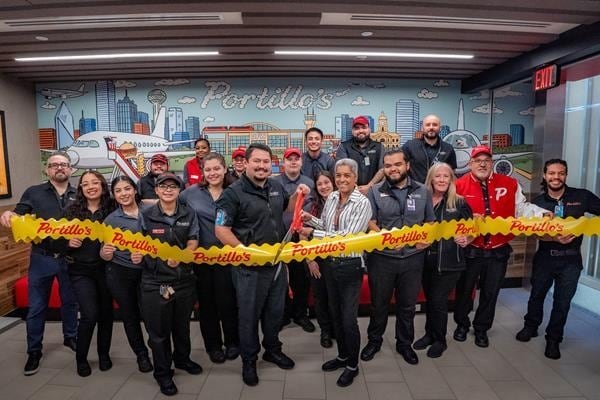
The travel-optimized restaurant format introduced by Portillo's at Dallas Fort Worth International Airport adapts the brand's dining experience for travelers seeking speed, convenience, and flexibility. Unlike a traditional restaurant, the compact location incorporates self-order kiosks, register ordering, order-ahead pickup, and a dedicated grab-and-go section, allowing customers to choose the service option that best fits their schedule. The format also includes a streamlined footprint while maintaining access to Portillo's signature menu offerings and a dedicated breakfast selection.
This approach reflects growing demand for efficient dining experiences in airports and other high-traffic transit environments. As travelers increasingly prioritize convenience and time-saving services, restaurant operators are exploring smaller, digitally enabled concepts that can serve more customers with less space. For foodservice brands, transportation hubs, and retail operators, these formats create opportunities to expand into premium locations, improve operational efficiency, and capture demand from consumers looking for quick, reliable meal options while on the move.
Image Credit: Portillo's
Key Themes Behind This Trend
- Compact Transit Dining
- Smaller restaurant footprints in airports and transit hubs create new growth potential for brands that can deliver full-menu familiarity within space-constrained, high-volume environments.
- Flexible Ordering Formats
- Digital kiosks, register service, order-ahead pickup, and grab-and-go merchandising reflect a shift toward dining systems that accommodate varied traveler timelines and service preferences.
- Speed-centric Foodservice
- Time-sensitive consumers are reshaping restaurant design around faster throughput, simplified operations, and reliable access to recognizable meals during travel.
Where This Applies
- Airport Retail
- Premium terminal locations increasingly favor compact, tech-enabled food concepts that maximize passenger convenience while improving revenue density for operators.
- Quick-service Restaurants
- Established foodservice brands have a pathway to extend into nontraditional venues by adapting signature menus into efficient formats suited for mobile consumers.
- Travel Hospitality
- Transit-focused hospitality ecosystems are being redefined by integrated meal options that blend convenience, brand recognition, and operational flexibility for on-the-go guests.