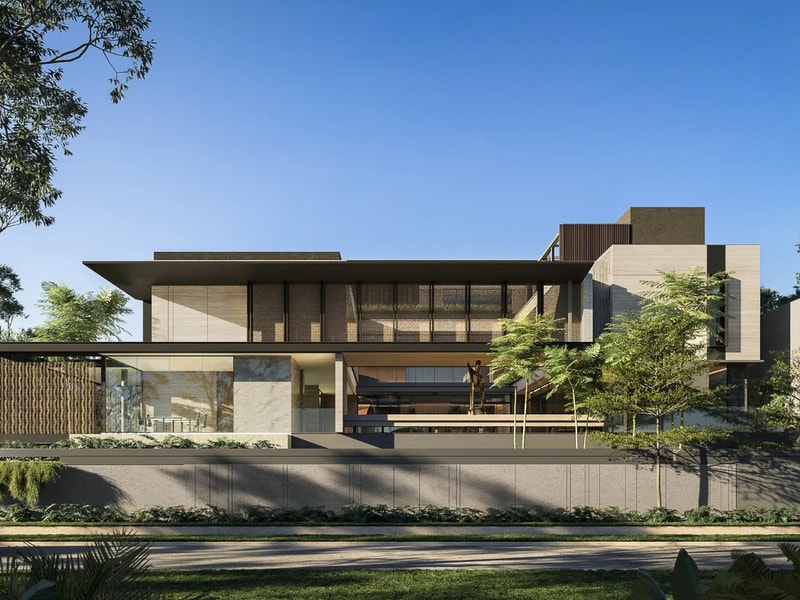
SE House is a private residence designed by Giovanni Gunawan of KantorGG in Surabaya, Indonesia. SE House is organized around a central courtyard that serves as the primary spatial focus of the home. The layout uses voids, dry gardens, and open-air connections to bring natural light and airflow into the interior. Rather than relying on expansive glazing and outward-facing spaces, the design directs attention toward internal gardens and shared outdoor areas. Existing mature trees on the site were preserved and incorporated into the overall composition.
The residence follows KantorGG’s approach of integrating nature into daily living through architecture. Dry gardens separate built volumes while maintaining visual and environmental connections between spaces. The house uses a 360-degree courtyard arrangement that gives multiple rooms direct access to the central landscape. This configuration eliminates a single dominant view and distributes light, greenery, and outdoor space throughout the home. The project also reflects influences from Australian residential architecture, which Gunawan adapted to the local climate and context.
Image Credit: Tristan Salim
Why This Trend Is Growing
- Courtyard-centric Residential Design
- A model of compact courtyard cores redefines urban lot utility by prioritizing shared microclimates and inward-facing social spaces.
- Biophilic Interior Voids
- Intermittent dry gardens and voids function as integrated daylighting and passive cooling networks within compact floorplans.
- Distributed Light and Airflow Planning
- 360-degree courtyard arrangements produce equitable daylight distribution and cross-ventilation, challenging conventional perimeter glazing strategies.
Industries Being Reshaped
- Residential Architecture
- Inward-focused planning introduces a typology that shifts emphasis from façade-driven showpieces to internally layered living and adaptable room adjacencies.
- Landscape Architecture
- Preserving mature trees as compositional anchors repositions landscape elements as primary spatial organizers rather than peripheral ornaments.
- Sustainable Building Materials
- Demand for materials optimized for humidity management and thermal mass in open courtyards highlights opportunities for novel porous and evaporative surface systems.