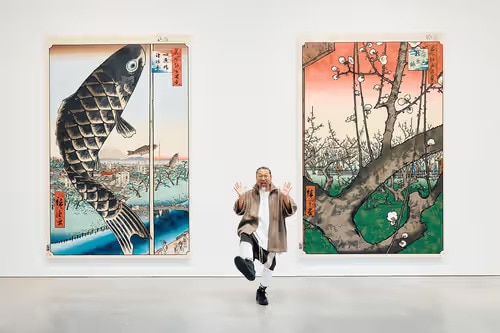
Japonisme Cognitive Revolution Learning from Hiroshige opens at Kaikai Kiki Gallery Tokyo as an exhibition by Takashi Murakami. The show focuses on Murakami’s study of Japanese ukiyo-e traditions, with specific reference to works by Edo-period artist Utagawa Hiroshige. Paintings and mixed-media works reinterpret compositional structures, color fields, and spatial perspectives found in historical woodblock prints. Murakami applies these elements across large-scale canvases using contemporary materials and production techniques.
The exhibition includes newly produced works displayed throughout the gallery in a linear layout. Visual motifs are repeated and layered to emphasize pattern, rhythm, and surface density. Traditional landscape elements are combined with Murakami’s established graphic language, including simplified forms and saturated color palettes. Works are presented without chronological separation, allowing formal relationships to emerge through proximity and scale. The exhibition is presented by Kaikai Kiki Gallery in Tokyo as part of Murakami’s ongoing research into Japanese art history and visual structure.
Image Credit: Kaikai Kiki Gallery Tokyo, Takashi Murakami
Key Themes Behind This Trend
- Cultural Fusion Art
- Takashi Murakami's exhibition exemplifies a fusion of traditional Japanese ukiyo-e art and contemporary visual techniques, creating new dialogues in cross-cultural artistic expression.
- Interactive Art Installations
- By utilizing large-scale canvases and mixed media, the exhibition invites viewers to engage with art in a dimensional manner, offering novel ways to experience and interact with artworks.
- Pattern and Rhythm in Modern Art
- The use of repetitive visual motifs and layered compositions highlights the emerging trend of harnessing pattern and rhythm to create dynamic, immersive art experiences.
Where This Applies
- Art Galleries
- Galleries can explore innovative curation strategies that integrate traditional and modern artworks, appealing to diverse audiences seeking both cultural heritage and contemporary creativity.
- Digital Art Production
- The combination of historical art techniques with modern production technologies fuels advancements in digital art mediums, expanding the possibilities for new artistic creations.
- Cultural Heritage Tourism
- Exhibitions like Murakami's attract global audiences, impacting tourism by offering unique cultural experiences that blend historical art with modern interpretations.