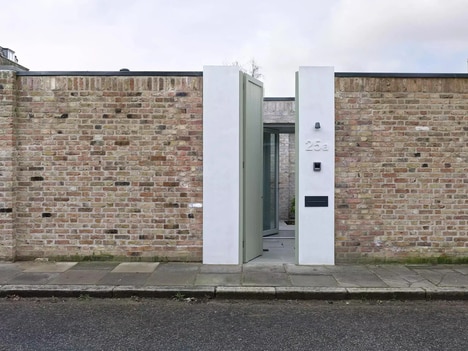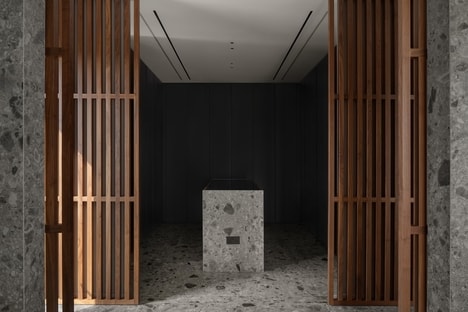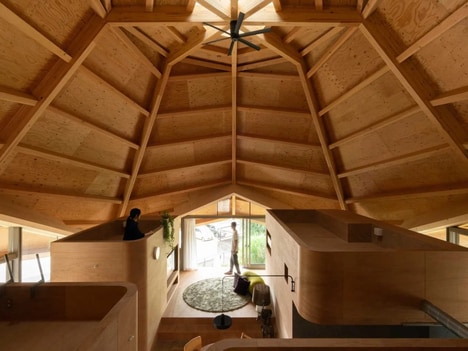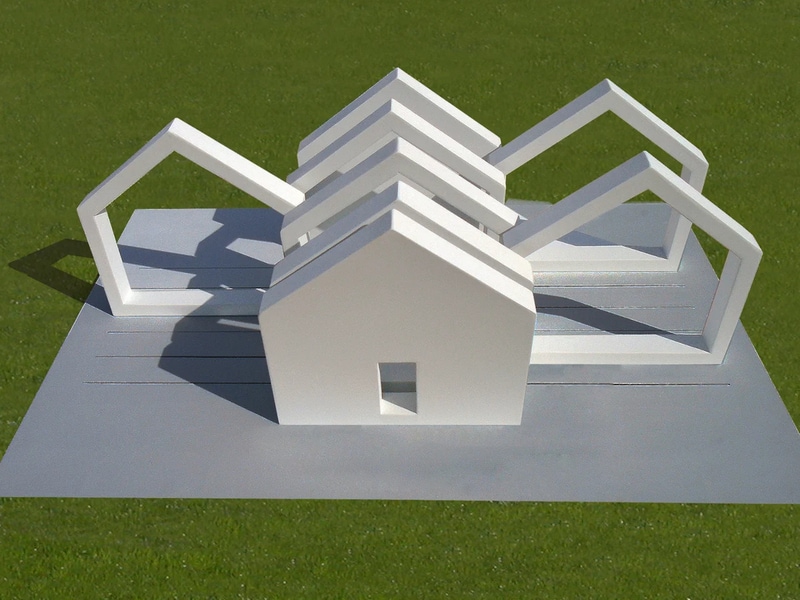
The Interactive Sliced House reinterprets the familiar silhouette of a pitched-roof home through an interactive structure composed of eight vertical sections. Designer Michael Jantzen anchors two solid white steel end panels to a concrete foundation, while six open house-shaped frames slide freely along integrated tracks between them. The movable frames allow visitors to continuously reconfigure the installation, creating changing thresholds, corridors, and sightlines that alter how people experience the surrounding landscape and one another.
The installation presents a different spatial arrangement each time the frames are repositioned, encouraging repeated interaction rather than a fixed viewing experience. White painted steel maintains a consistent appearance regardless of the configuration, ensuring that no single arrangement becomes the intended final form. Doorway openings within the end panels reinforce the architectural reference. Multiple installations can also be placed within the same site to expand the interactive experience across a larger public space.
Image Credit: Michael Jantzen
What Makes This Trend Stand Out
- Kinetic Public Art
- Movable sculptural structures introduce adaptable public experiences where audiences become part of the artwork through physical reconfiguration.
- Participatory Spatial Design
- Visitor-controlled frames and thresholds suggest new models for environments that shift social interaction, circulation, and perception in real time.
- Modular Landmark Installations
- Repeatable architectural modules provide flexible site activations that can scale across plazas, parks, and cultural districts without relying on a fixed final form.
Sectors Adopting This
- Public Art
- Interactive installations expand civic art beyond static display by blending sculpture, play, and shared authorship in open public settings.
- Architecture
- Experimental house-like structures reveal opportunities for buildings and spatial prototypes that prioritize adaptability, movement, and changing user experience.
- Urban Planning
- Configurable public-space features support more dynamic placemaking strategies where streetscapes and gathering areas can evolve with community use.