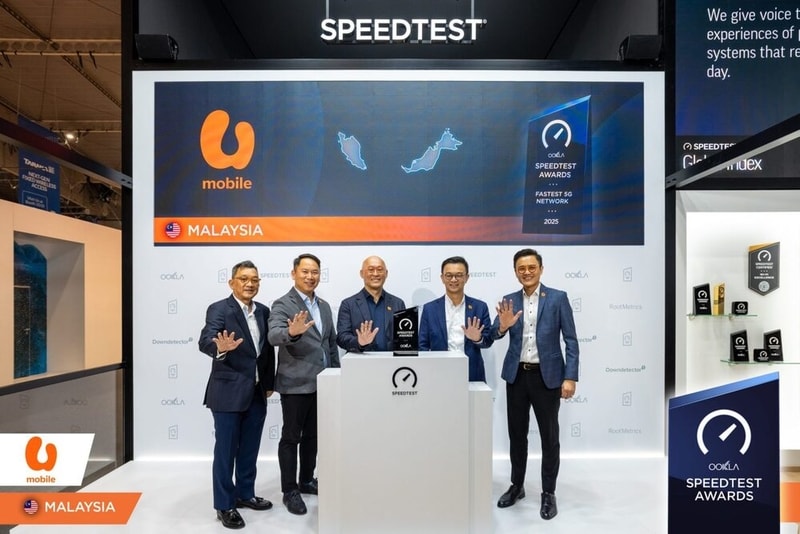
U Mobile launched its ULTRA5G network, featuring large antenna arrays and 64T64R radio systems to boost real-world 5G speeds across Malaysia. Ookla’s Speedtest data named U Mobile the fastest 5G network in Q3–Q4 2025, highlighting performance measured from millions of user tests. The rollout combined hardware and software upgrades designed to expand coverage and capacity.
The deployment included Huawei’s MetaAAU antenna modules, a 384-dipole design that extends signal reach and improves indoor coverage, plus iBeam beamforming software to track users and stabilise links. U Mobile also announced collaboration with ZTE to trial AIR Core, an AI-native core platform and digital twin tools to simulate network changes before live use. The company reported ongoing investment to hit 80% populated-area coverage by H2 2026.
For consumers, the upgrades translated into faster downloads, lower latency under load and more reliable video calls and streaming, according to company statements and Ookla’s award. The move underscores a broader telecom trend: combining advanced radio hardware with AI-ready core systems to turn lab gains into everyday experience improvements.
Image Credit: Techwire Asia
Why This Trend Is Growing
- Massive Mimo Evolution
- The expansion of large array antennas and 64T64R radios is enabling orders-of-magnitude improvements in spectral efficiency and multi-user capacity that could redefine cell site design and density economics.
- AI-native Core Networks
- Networks built around AI-native cores and platforms like AIR Core are making real-time policy, self-optimisation and predictive maintenance native capabilities rather than aftermarket add-ons, changing how service quality is delivered at scale.
- Digital Twin Network Simulation
- The use of digital twins for pre-deployment simulation is allowing operators to model complex radio environments and traffic scenarios, reducing rollout risk and accelerating feature validation cycles.
Industries Being Reshaped
- Telecommunications Operators
- Carriers upgrading to MetaAAU-style hardware and AI-ready cores face opportunities to offer tiered ultra-reliable low-latency services and new SLAs that shift value away from pure coverage metrics.
- Consumer Streaming and Media
- Lower latency and more consistent throughput under load are enabling richer interactive and high-bitrate streaming experiences that could transform content formats and distribution economics.
- Enterprise Iot and Smart Cities
- Improved indoor coverage and beamformed links create the conditions for dense IoT deployments and real-time city control systems that require deterministic connectivity and predictable performance.