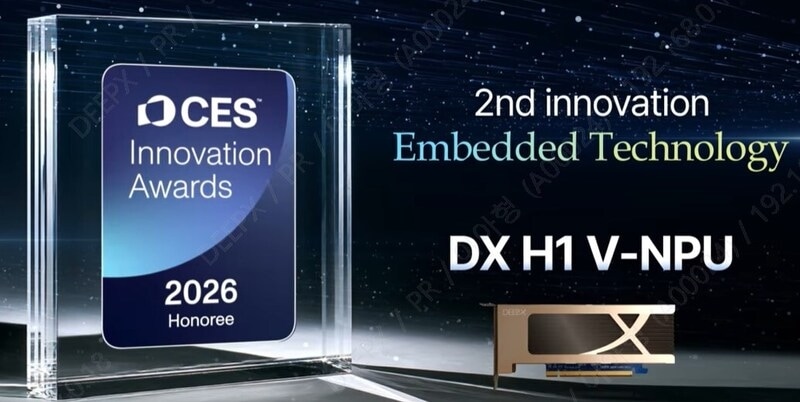
DEEPX, a company specializing in semiconductors for artificial intelligence applications located at the edge of a network, has officially announced a new vision neural processing unit — the DX-H1 V-NPU.
The product is engineered to consolidate several functions required for video analytics — including decoding streams, performing AI analysis, and re-encoding — onto a single, specialized chip that operates at a low power consumption level. The manufacturer claims significant advantages in both hardware expenditure and energy usage when directly comparing the vision neural processing unit to traditional server configurations, many of which are reliant on multiple general-purpose graphics processing units. DEEPX states that use of its DX-H1 V-NPU is expected to deliver an 80% reduction in system costs and an 85% decrease in power draw.
The chip has already received a product innovation award from CES 2026.
Image Credit: DEEPX
What's Driving This Trend
- Consolidated Video Analytics
- Integrating multiple video processing functions onto a single chip addresses inefficiencies in traditional server setups, offering disruptive cost and power advantages.
- Low-power AI Chips
- Designing AI-specific chips with minimal energy consumption presents a path to overcoming the growing demands for sustainable computing solutions.
- Edge AI Processing
- Enhancing AI capabilities at the network edge reduces latency and bandwidth use, driving the innovation of smarter, faster local devices.
Who This Affects Most
- Semiconductor Manufacturing
- Developing specialized chips that merge multiple functionalities fosters advancements in AI hardware efficiency.
- Video Surveillance
- Incorporating advanced neural processing units into surveillance technology transforms the landscape by enabling more accurate and cost-effective monitoring systems.
- Energy Management
- Utilizing low-power processing units in electronic devices offers a substantial disruptive potential in global energy consumption patterns.